
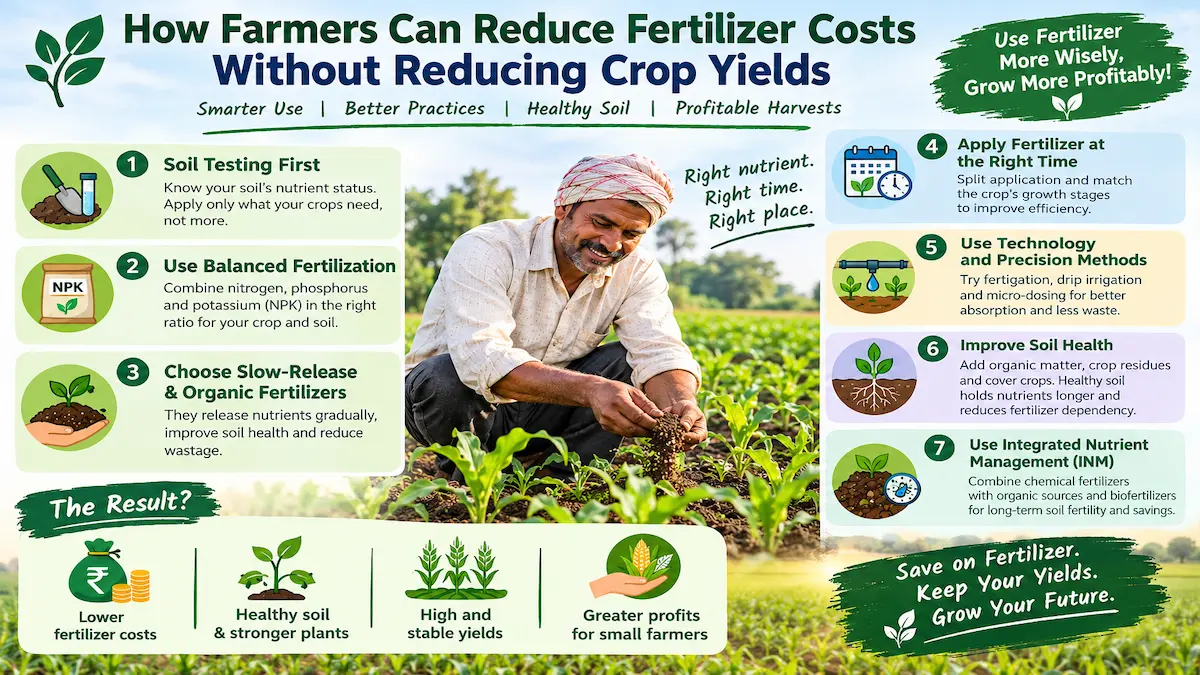
Fertilizer is one of the most important inputs in modern agriculture, but it can also be one of the biggest expenses on a farm. When fertilizer prices rise, farmers often face a difficult question: How can I reduce fertilizer costs without reducing production?
The answer is not simply to stop using fertilizer. Crops need nutrients, and insufficient nutrition can reduce plant growth, crop quality, and yield. The smarter approach is to use the right nutrients, in the right quantity, at the right time and in the right place.
Fortunately, farmers can reduce unnecessary fertilizer expenses through better soil management, organic matter, crop rotation, improved application methods, and careful farm planning.
Here are practical strategies that can help farmers save money while maintaining healthy crops and productive soils.
1. Start With a Soil Test
One of the easiest ways to waste money on fertilizer is to apply nutrients without knowing what the soil actually needs.
A soil test provides information about important factors such as nitrogen, phosphorus, potassium, pH, and organic matter. It can help farmers identify nutrients that are deficient and, equally importantly, nutrients that are already present in sufficient quantities.
For example, if a field already contains adequate phosphorus, applying additional phosphorus fertilizer may provide little benefit while increasing production costs.
Instead of following the same fertilizer schedule every year, farmers can use soil-test information to develop a more precise nutrient plan.
The cheapest fertilizer is often the fertilizer you don’t need to buy.
2. Follow the “Right Source, Right Rate, Right Time, Right Place” Principle
Efficient fertilizer management can be summarized through four basic ideas:
- Right source – choose the nutrient source appropriate for the crop and soil.
- Right rate – apply only the quantity required.
- Right time – apply nutrients when crops can use them effectively.
- Right place – position nutrients where crop roots can access them.
This approach reduces nutrient losses and improves fertilizer-use efficiency.
Applying a large quantity of fertilizer at once may appear convenient, but some nutrients can be lost through runoff, leaching, volatilization, or other processes before plants can use them.
Better timing can therefore save money without necessarily reducing crop nutrition.
3. Do Not Apply Fertilizer “Just in Case”
A common farming habit is to apply extra fertilizer because farmers fear that a lower quantity might reduce yield.
However, more fertilizer does not automatically mean more production.
Once the crop’s nutrient requirements are adequately met, additional fertilizer may provide little extra benefit. In some situations, excessive nutrients can even cause problems such as excessive vegetative growth, nutrient imbalance, lodging, environmental pollution, or greater susceptibility to certain pests and diseases.
Farmers should therefore avoid the mentality that “more fertilizer means more yield.”
The goal should be maximum return from every kilogram of fertilizer applied.
4. Improve Soil Organic Matter
Healthy soil can make nutrients more available to crops and improve the efficiency of fertilizer use.
Organic materials such as compost, farmyard manure, crop residues, and properly prepared vermicompost can contribute organic matter to the soil.
Organic matter improves soil structure, moisture retention, microbial activity, and nutrient cycling.
This does not mean farmers should immediately eliminate chemical fertilizers. Instead, combining appropriate mineral fertilizers with locally available organic resources can create a more balanced nutrient-management system.
For farmers with livestock, properly managed manure can be particularly valuable because it turns an agricultural waste product into a useful farm input.
5. Make Compost From Farm Waste
Many farms produce materials that are thrown away or burned but could instead be converted into valuable organic fertilizer.
Crop residues, dry leaves, animal manure, vegetable waste, and other biodegradable materials can be composted under suitable conditions.
Instead of purchasing all soil amendments from outside the farm, farmers can recycle part of their own resources.
Composting requires some labor and management, but it can reduce dependence on purchased inputs over time.
It also helps return nutrients and organic matter to agricultural land.
6. Use Crop Residues Wisely
After harvesting, farmers often have large quantities of straw, leaves, stalks, and other crop residues.
Burning these residues removes valuable organic material and can contribute to air pollution.
Where appropriate and practical, crop residues can be incorporated into the soil, composted, used as mulch, or utilized for livestock feed.
Returning suitable organic residues to the soil can contribute to nutrient cycling and improve soil organic matter.
However, residues should be managed according to the crop, soil, local climate, and disease situation. In some cases, removal or alternative uses may be appropriate.
7. Grow Legume Crops
Legumes can play an important role in reducing dependence on external nitrogen inputs.
Crops such as chickpea, lentil, pea, soybean, beans, and several other legumes have relationships with nitrogen-fixing bacteria associated with their roots.
When properly managed, legumes can contribute nitrogen to the farming system and improve crop rotation.
For example, a farmer growing cereals continuously may consider introducing a pulse crop into the rotation.
Besides helping with nutrient management, pulses can provide an additional source of food and income.
8. Practice Crop Rotation
Growing the same crop year after year can increase nutrient depletion and create greater pest and disease pressure.
Crop rotation allows farmers to vary nutrient demands and biological conditions in the field.
A cereal crop followed by a pulse crop is one possible rotation. Farmers can also include oilseeds, fodder crops, vegetables, or cover crops depending on local conditions.
Good crop rotation can improve soil health and reduce some production problems, potentially lowering the need for certain inputs.
The ideal rotation will depend on climate, soil type, irrigation, market demand, and available machinery.
9. Apply Fertilizer Near the Root Zone
Where suitable for the crop, placing fertilizer closer to the active root zone can improve nutrient availability.
Broadcasting fertilizer across the entire field may result in nutrients being placed where crop roots cannot efficiently access them.
Methods such as band placement or localized application can sometimes improve fertilizer efficiency.
This is particularly useful for certain crops and nutrient types.
However, fertilizer should not be placed so close to seeds or roots that it causes fertilizer injury. Farmers should follow crop-specific recommendations.
10. Split Nitrogen Applications
Nitrogen is particularly vulnerable to losses when it is applied in large quantities at the wrong time.
Instead of applying the entire nitrogen requirement at once, farmers can sometimes divide applications into multiple doses according to crop growth stages.
This allows the crop to receive nitrogen when its demand is higher.
For irrigated crops, split applications can also reduce the risk of nutrients being lost through water movement.
The exact timing and quantity should depend on the crop, soil, weather, irrigation method, and local agricultural recommendations.
11. Avoid Fertilizing Before Heavy Rain
Applying fertilizer immediately before heavy rainfall can be a costly mistake.
Water can move nutrients away from the root zone through runoff or leaching, depending on the nutrient, soil, slope, and rainfall intensity.
Farmers should monitor weather conditions and avoid unnecessary applications when significant rainfall is expected.
Good weather-based decision-making can prevent fertilizer from literally being washed away from the field.
12. Control Irrigation Properly
Fertilizer and water management are closely connected.
Excessive irrigation can move soluble nutrients below the crop’s effective root zone, particularly in light or sandy soils.
At the same time, insufficient water can prevent crops from taking up nutrients efficiently.
Farmers should therefore manage irrigation according to crop requirements, soil moisture, weather conditions, and the growth stage of the crop.
Efficient irrigation systems such as drip irrigation can be particularly useful for suitable crops because water and nutrients can be delivered more precisely.
13. Check Fertilizer Prices—But Don’t Buy Based Only on the Cheapest Bag
Farmers should compare fertilizer prices, but price per bag alone can be misleading.
Different fertilizers contain different concentrations of nutrients. A cheaper bag is not necessarily cheaper per kilogram of nutrient.
Farmers should calculate the cost per unit of nutrient and consider transportation, application, storage, and expected effectiveness.
Buying the correct product in the correct quantity is often more economical than simply choosing the lowest-priced bag.
14. Store Fertilizer Properly
Poor storage can turn purchased fertilizer into wasted money.
Fertilizers should be stored in a dry, protected location according to the manufacturer’s instructions. Bags should be protected from moisture and contamination.
Damaged or improperly stored fertilizer can become difficult to handle and may suffer losses in quality.
Farmers should also keep records of how much fertilizer they purchase and use.
A simple inventory can prevent unnecessary purchases and help identify where fertilizer is being used most heavily.
15. Consider Fertilizer Blends Carefully
Fertilizer blends can be useful when they match the actual nutrient requirements of a crop and field.
However, farmers should avoid buying a fertilizer containing nutrients that their soil does not require simply because it is conveniently packaged.
For example, if soil testing shows that one nutrient is already sufficient, repeatedly applying a compound fertilizer containing large amounts of that nutrient may create unnecessary expense.
The fertilizer program should be designed around crop demand and soil conditions, not merely around the products available in the local market.
16. Improve Weed Control
Weeds compete with crops for nutrients, water, sunlight, and space.
If a significant portion of applied fertilizer is taken up by weeds rather than the crop, fertilizer efficiency decreases.
Good weed management can therefore indirectly improve the return farmers receive from fertilizer.
Farmers can use appropriate combinations of cultivation, mulching, crop competition, mechanical methods, and approved herbicides where necessary.
The objective is to control weeds effectively while avoiding unnecessary expenses.
17. Reduce Soil Erosion
When fertile topsoil is lost through wind or water erosion, nutrients can be lost along with it.
Soil conservation practices such as maintaining ground cover, mulching, contour farming, reduced tillage, cover crops, terraces, and suitable vegetation barriers can help protect valuable soil.
Protecting soil is essentially protecting the farmer’s previous investments in nutrients and organic matter.
A farmer who loses topsoil today may have to spend more money on fertilizers and soil improvement tomorrow.
18. Use Biofertilizers Where They Are Appropriate
Biofertilizers contain beneficial microorganisms that can support nutrient availability or biological nutrient processes.
Examples include microbial products associated with nitrogen fixation or improved phosphorus availability.
Biofertilizers are not a magical replacement for all fertilizers, and their effectiveness can vary according to crop, soil, climate, product quality, and management.
However, when an appropriate product is used correctly, it may complement other nutrient-management practices.
Farmers should purchase products from reliable sources and follow recommended application methods.
19. Keep Records and Calculate Fertilizer Efficiency
Farmers can learn a great deal by keeping simple records.
Record:
- Fertilizer purchased
- Quantity applied
- Cost
- Crop yield
- Crop variety
- Irrigation
- Major pest or disease problems
- Selling price
After harvest, compare fertilizer costs with yield and income.
Suppose one field receives a very high fertilizer dose but produces only slightly more than another field using a moderate dose. The additional fertilizer may not have generated enough extra income to justify its cost.
This type of record-based decision-making can gradually make a farm more profitable.
20. Think About Fertilizer as an Investment, Not Just an Expense
Perhaps the most important change is to stop thinking about fertilizer simply as something that must be purchased every season.
Fertilizer is an investment in crop nutrition. Like any investment, it should generate a return.
The question should not be:
“How can I use less fertilizer?”
Instead, ask:
“How can I produce more crop from every rupee spent on fertilizer?”
Sometimes the answer will be reducing fertilizer. Sometimes it will be changing the fertilizer source. In other cases, the solution may be better timing, improved irrigation, soil organic matter, crop rotation, or better placement.
Conclusion
Reducing fertilizer costs does not mean starving crops of nutrients. It means eliminating waste and improving nutrient-use efficiency.
Farmers can begin with simple steps: test the soil, understand crop nutrient requirements, avoid unnecessary applications, improve organic matter, recycle farm residues, introduce suitable legumes, rotate crops, manage irrigation carefully, and apply nutrients at the right time and place.
These practices can provide two important benefits. They can reduce the money spent on unnecessary fertilizer while protecting the long-term health of the soil.
For small farmers especially, every saved rupee matters. A farm does not become more profitable simply by producing the highest possible yield. True profitability comes from producing a good crop while controlling the cost of every input.
The future of farming will not necessarily belong to farmers who use the most fertilizer. It will increasingly belong to those who understand their soil, know what their crops need, use resources efficiently, and turn every input into maximum value.
Smart fertilizer management is not about using less—it is about wasting less.