
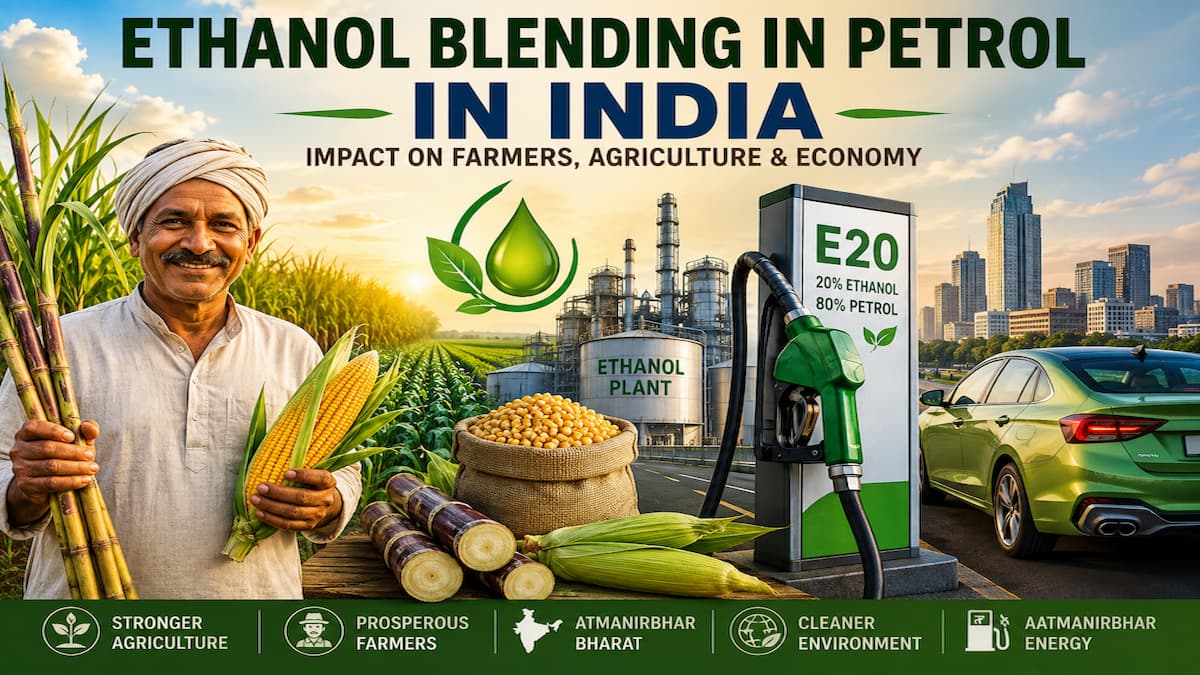
Ethanol Blending in Petrol and the Indian Farmer: What Is the Real Impact on Agriculture and the Indian Economy?
Ethanol blending in petrol has become one of India’s most important links between agriculture and energy policy. What began as a relatively small biofuel programme has developed into a major market for sugarcane, molasses, maize and other feedstocks.
India has now reached its 20% ethanol blending target (E20) in the 2025–26 ethanol supply year, compared with less than 1.5% in 2013–14. Ethanol procurement has risen from about 38 crore litres in 2013–14 to more than 1,200 crore litres projected for 2025–26, while production capacity has expanded from about 421 crore litres in 2014 to around 2,000 crore litres in 2026.
But an important question remains:
Does ethanol blending genuinely make the Indian farmer richer, or does it mainly create benefits for sugar mills, ethanol producers, oil companies and the wider economy?
The answer is more complicated than either extreme.
Ethanol blending can create a large and dependable agricultural market, reduce India’s dependence on imported crude oil and provide an additional outlet for agricultural commodities. At the same time, it can increase competition for crops such as maize and sugarcane, put pressure on water resources, affect food and feed markets, and provide very different benefits to different categories of farmers.
What Is Ethanol Blending?
Ethanol is an alcohol that can be produced from biological materials. In India, important feedstocks include sugarcane molasses, sugarcane juice/syrup and grains such as maize.
When petrol contains 20% ethanol and 80% petrol by volume, it is called E20.
The basic idea is simple:
Agricultural crop → ethanol plant → ethanol → blended with petrol → vehicle fuel
This creates a connection between the farm and the fuel pump.
Instead of using only imported petroleum to power vehicles, a portion of the fuel comes from domestically produced agricultural material.
That is strategically important for India because the country has historically depended heavily on imported crude oil.
Why Is India Promoting Ethanol?
India’s ethanol programme has several objectives.
1. Reduce crude-oil imports
India imports a large proportion of the crude oil it consumes. Every litre of domestically produced ethanol that substitutes for petrol reduces the amount of petroleum-based fuel required.
The government has reported substantial foreign-exchange savings and crude-oil substitution from the ethanol programme.
This is particularly important because international oil prices can change rapidly because of wars, geopolitical tensions, production cuts and supply disruptions.
2. Create a market for farmers
Ethanol creates another buyer for agricultural commodities.
For example, a maize farmer traditionally depends on:
- poultry-feed demand,
- livestock-feed demand,
- starch industries,
- food markets,
- traders and exporters.
With ethanol production, fuel becomes another major demand source.
This diversification can be valuable when conventional agricultural markets are weak.
3. Support the sugar industry
India’s sugar industry has historically faced a structural problem: sugar production can sometimes exceed domestic demand.
Excess sugar can depress prices and create financial stress for sugar mills.
Diversion of sugarcane-derived material toward ethanol gives mills another revenue stream.
4. Reduce greenhouse-gas emissions
Biofuels can reduce lifecycle greenhouse-gas emissions compared with fossil fuels, although the actual environmental benefit depends heavily on how the ethanol is produced.
Ethanol made from agricultural waste or other advanced feedstocks can have a different environmental footprint from ethanol produced using resource-intensive crops.
Therefore, saying simply that “ethanol is green” is too simplistic.
The Biggest Question: Does Ethanol Increase Farmer Income?
This is where the discussion becomes interesting.
Ethanol does not automatically increase every farmer’s income.
Its impact depends on:
- which crop the farmer grows,
- farm size,
- productivity,
- irrigation availability,
- distance from the processing plant,
- procurement price,
- transport costs,
- local market competition,
- input prices,
- and whether ethanol demand replaces or supplements other markets.
For a sugarcane farmer located close to a functioning sugar mill/distillery, ethanol demand can strengthen the economics of sugarcane.
For a maize farmer, ethanol demand can provide an additional market and potentially improve price realization.
But there is an important distinction:
Higher crop demand ≠ automatically higher farm income.
Suppose the price of maize rises because ethanol producers are buying more maize.
The farmer receives a higher selling price.
That sounds positive.
But if:
- fertiliser becomes more expensive,
- diesel becomes more expensive,
- labour costs rise,
- irrigation costs rise,
- land rent increases,
the farmer’s net income may increase much less than the crop’s selling price.
Therefore, the correct measure is not simply:
“What price did the farmer receive?”
It is:
Farm income = Crop revenue − Total cost of cultivation
That distinction is often missing from public discussions about ethanol.
Ethanol’s Positive Impact on Sugarcane Farmers
Sugarcane is perhaps the most obvious agricultural beneficiary of India’s ethanol policy.
India’s sugar industry can convert sugarcane into several valuable products:
Sugarcane → Sugar + Molasses/Ethanol + Bagasse + Other by-products
This gives the industry multiple revenue streams.
Greater ethanol demand can therefore help sugar mills manage periods of excess sugar production.
For farmers, this can indirectly improve the financial health of sugar mills and their ability to make payments for cane.
The ethanol market can also reduce the industry’s dependence on sugar alone.
But there is a limitation.
Sugarcane is a water-intensive crop.
If ethanol policy encourages excessive expansion of sugarcane in water-stressed regions, the agricultural benefit could come with a significant environmental cost.
This is particularly important in parts of Maharashtra and Karnataka where water availability can already be a serious concern.
Therefore:
Ethanol may increase the economic value of sugarcane, but increasing sugarcane cultivation everywhere is not necessarily good agricultural policy.
Maize: The Potential New Winner
One of the most important long-term effects of India’s ethanol programme could be the growing role of maize.
Maize has an advantage because it can serve several markets:
- human consumption,
- poultry feed,
- livestock feed,
- starch,
- industrial products,
- ethanol.
Ethanol therefore gives maize farmers another potential buyer.
This could encourage farmers to expand maize cultivation in regions where the crop is agronomically suitable.
It could also encourage:
- better hybrids,
- improved irrigation,
- mechanisation,
- better post-harvest management,
- drying facilities,
- storage,
- and local processing.
This can gradually create an agricultural ecosystem around maize.
But There Is a Serious Maize Problem
The same thing that makes ethanol attractive for maize farmers can create problems for consumers and livestock producers.
Imagine that a farmer has two potential buyers:
Poultry industry → maize
Ethanol industry → maize
If ethanol producers are willing to pay more, maize may move toward ethanol production.
That can reduce availability for:
- poultry feed,
- cattle feed,
- starch,
- food products.
The result can be higher maize prices.
For the maize farmer, this is good.
For a poultry farmer, it may be bad.
For consumers buying chicken or eggs, higher feed costs can eventually become higher food prices.
This illustrates an important economic principle:
A policy can benefit one part of agriculture while increasing costs for another part.
Therefore, ethanol policy should not be evaluated only from the perspective of sugarcane or maize farmers.
Ethanol and Food Security: The Major Debate
Perhaps the most important long-term question is:
Should food crops be used to produce fuel?
This is not a simple yes-or-no question.
India needs:
- food,
- animal feed,
- fuel,
- industrial raw materials,
- farmer income,
- and export earnings.
All of these compete for agricultural resources.
If a crop is diverted toward ethanol when supplies are abundant, the economic impact may be relatively small.
But if agricultural production is affected by:
- drought,
- floods,
- heatwaves,
- pests,
- climate change,
then competition between food, feed and fuel can become much more serious.
This is why India’s ethanol strategy needs flexibility.
During years of abundant grain production, more grain can potentially move toward industrial uses.
During years of food shortages, food security should receive priority.
Ethanol’s Impact on Indian Agriculture
The ethanol programme is likely to reshape agriculture in several ways.
1. Crop diversification
Ethanol demand may encourage farmers to consider maize and other suitable feedstocks.
This could reduce excessive dependence on a small number of crops.
2. Greater commercialisation
Farmers may increasingly grow crops according to industrial demand rather than solely according to traditional local markets.
3. Contractual and organised procurement
Large processing industries can encourage more structured procurement systems.
4. Expansion of rural processing
Ethanol plants create demand for:
- transport,
- storage,
- grain handling,
- machinery,
- engineering,
- maintenance,
- laboratories,
- logistics.
This can create rural non-farm employment.
5. More value addition
Instead of selling agricultural produce only as raw material, farmers become connected to a larger processing chain.
That is potentially one of the biggest long-term benefits.
Ethanol and Small Farmers
However, the benefits may not be evenly distributed.
A large farmer producing hundreds of tonnes of a commercial crop is in a much stronger position than a farmer producing a few tonnes.
Large farmers may have:
- better machinery,
- irrigation,
- storage,
- access to information,
- transportation,
- stronger bargaining power.
Small farmers may still sell through local traders.
Consequently, the ethanol economy could potentially increase agricultural income without equally increasing the income of every farmer.
This is why farmer producer organisations (FPOs), cooperatives and collective marketing can become extremely important.
If thousands of small farmers collectively supply an ethanol plant, their bargaining position can improve.
Does Ethanol Make Petrol Cheaper?
This is another common misunderstanding.
Replacing some petrol with ethanol does not automatically mean that petrol at the pump will become dramatically cheaper.
The retail price of petrol depends on many factors:
- crude-oil prices,
- refining costs,
- taxes,
- transportation,
- marketing margins,
- exchange rates,
- government policy,
- and the cost of ethanol.
Therefore, ethanol’s economic value should not be measured simply by asking:
“Did petrol become cheaper?”
The more important question is:
“How much imported petroleum did India avoid purchasing?”
That is a broader national economic benefit.
Impact on India’s Foreign Exchange
This is arguably one of the strongest arguments for ethanol.
India purchases crude oil from international markets.
Those transactions require foreign currency.
When domestic ethanol replaces part of the petrol requirement, India can reduce the petroleum volume it needs to source from abroad.
This can help reduce the country’s exposure to international oil-price shocks.
The government has reported significant foreign-exchange savings from ethanol blending since the programme expanded.
But these savings should be interpreted carefully.
Foreign-exchange saving is not the same as economic profit.
India also spends money on:
- producing ethanol,
- transporting it,
- building distilleries,
- purchasing feedstock,
- storing ethanol,
- upgrading infrastructure.
The real economic benefit is the net value of the imported petroleum displaced minus the domestic resources used to produce and distribute ethanol.
That is the more meaningful economic calculation.
Ethanol and India’s Rural Economy
The ethanol industry is not only about farmers.
It can generate an entire rural-industrial ecosystem.
Consider the chain:
Farmer
↓
Collection/Procurement
↓
Transport
↓
Sugar Mill / Grain Processor
↓
Distillery
↓
Ethanol Storage
↓
Oil Marketing Company
↓
Petrol Pump
↓
Consumer
Thousands of people can participate in this chain.
Employment can arise in:
- transport,
- mechanical maintenance,
- agricultural services,
- storage,
- laboratory testing,
- plant operations,
- equipment manufacturing,
- construction,
- logistics.
Thus, the economic impact can extend beyond the direct farmer payment.
The Hidden Cost: Water
This is one of the most important issues that should not be ignored.
Some ethanol feedstocks, particularly sugarcane, require substantial amounts of water.
Therefore, the question is not merely:
“How much ethanol can India produce?”
It should also be:
“How much ethanol can India produce sustainably with the available land and water?”
A litre of ethanol produced from one region may have a very different environmental cost from a litre produced using agricultural residues or more water-efficient systems elsewhere.
India should therefore encourage ethanol feedstocks according to regional resource availability.
Water-rich regions may be more suitable for certain crops.
Water-stressed regions should not be encouraged to expand water-intensive feedstocks simply because there is a guaranteed industrial market.
E20 and Vehicle Mileage: A Concern for Consumers
Ethanol contains less energy per litre than petrol.
Consequently, vehicles running on higher ethanol blends can experience some reduction in fuel economy, although the actual effect varies according to vehicle technology and driving conditions.
This creates an important consumer issue.
If a vehicle travels fewer kilometres per litre, the consumer needs to purchase fuel more frequently.
Therefore, comparing fuels purely by price per litre can be misleading.
The better measure is:
Cost per kilometre
For example:
If petrol costs ₹100 per litre and a vehicle achieves 15 km/litre:
Cost = ₹6.67/km
If an ethanol blend costs ₹95 per litre but the vehicle achieves 14 km/litre:
Cost = ₹6.79/km
In this hypothetical example, the cheaper litre does not mean cheaper transportation.
Actual results will vary by vehicle, blend and operating conditions.
What About Older Vehicles?
Vehicle compatibility is an important issue during the transition toward higher ethanol blends.
Newer vehicles can be designed or calibrated for higher ethanol blends.
Older vehicles may not necessarily deliver the same performance or compatibility.
Potential concerns can include:
- fuel-system material compatibility,
- corrosion,
- moisture absorption,
- seals and components,
- calibration,
- fuel economy.
This creates a policy challenge.
If a country moves rapidly toward E20, consumers should have clear information about:
- which vehicles are compatible,
- what changes manufacturers have made,
- expected mileage,
- warranty implications,
- and maintenance requirements.
A successful fuel transition requires consumer confidence, not just production capacity.
Environmental Benefits: Real but Conditional
Ethanol can reduce dependence on fossil fuels.
It can also contribute to lower lifecycle emissions depending on the feedstock and production process.
But the environmental calculation must include the complete production chain.
Consider maize ethanol:
Cultivation → fertiliser → irrigation → harvesting → transport → processing → ethanol → transport
Each stage consumes energy and resources.
Similarly, sugarcane ethanol has an environmental footprint involving:
- water,
- fertilisers,
- land,
- harvesting,
- transport,
- processing.
Therefore, the environmental benefit depends on how ethanol is produced, not merely on the fact that it is called biofuel.
The Big Opportunity: 2G Ethanol
The most exciting future possibility may be second-generation, or 2G, ethanol.
Instead of using food-oriented crops directly, 2G technology can convert agricultural residues and other lignocellulosic biomass into ethanol.
Potential raw materials include:
- crop residues,
- rice straw,
- wheat straw,
- bagasse,
- other agricultural biomass.
This could create a powerful combination:
Agricultural waste → ethanol → fuel
Instead of treating crop residue as waste, India could turn it into an economic resource.
This approach could potentially reduce the food-versus-fuel conflict.
It could also create additional income opportunities for farmers through the sale of agricultural residues.
However, collecting biomass economically is difficult.
Residues are:
- bulky,
- scattered,
- seasonal,
- expensive to transport.
Therefore, successful 2G ethanol requires local collection networks and strategically located processing plants.
Could Ethanol Help Solve Crop-Residue Problems?
Potentially, yes.
India produces huge quantities of agricultural residues.
Some residues are burned because farmers need to clear fields quickly and alternative disposal methods may be expensive.
A commercially viable biomass market could change the calculation.
Instead of:
Crop residue → waste → burning
the system could become:
Crop residue → collection → processing → ethanol → fuel
The farmer could receive payment.
The processing company receives raw material.
The country produces domestic fuel.
And potentially, fewer residues are burned.
This is a much more attractive long-term model than simply increasing the use of food crops for ethanol.
The Sugar Industry: Winner or Temporary Beneficiary?
The sugar industry has gained a major additional outlet through ethanol.
But there is a deeper question.
If ethanol becomes very profitable, sugar mills may divert more sugarcane-derived material toward ethanol.
That can improve mill economics.
However, if too much sugar is diverted, domestic sugar availability can tighten and sugar prices can rise.
Therefore, policymakers have to balance:
Sugar availability
against
Ethanol demand
This is why government policy sometimes needs to adjust the permitted diversion of sugar-related feedstocks depending on domestic supply conditions.
Who Are the Biggest Winners?
The ethanol economy has several potential winners.
1. Efficient sugarcane farmers
Especially those located near well-functioning sugar mills.
2. Maize farmers
Particularly those with access to ethanol procurement and good yields.
3. Sugar mills
They gain an additional revenue stream.
4. Ethanol producers
They gain from a large institutional market.
5. Rural transport and logistics
Higher agricultural processing creates additional movement of crops and ethanol.
6. The Indian economy
Reduced dependence on imported crude can improve energy security.
7. Consumers
Potentially through improved energy security and reduced exposure to international petroleum shocks.
Who Could Lose?
The disadvantages should be taken seriously.
Poultry industry
Higher maize prices can increase feed costs.
Livestock farmers
Feed costs may rise.
Consumers
Higher feed and agricultural prices can eventually affect food prices.
Owners of incompatible older vehicles
They may face transition and maintenance concerns.
Water-stressed agricultural regions
Expansion of water-intensive feedstocks can worsen resource pressure.
Small farmers without market access
They may not receive the full value generated by the ethanol supply chain.
Does Ethanol Really Increase India’s GDP?
Yes, potentially—but again, the mechanism matters.
GDP measures the value of goods and services produced within the economy.
When India produces ethanol domestically instead of importing petroleum products, domestic economic activity increases through:
- agriculture,
- processing,
- transportation,
- manufacturing,
- logistics,
- plant operations.
However, the net GDP impact is not simply equal to the value of ethanol produced.
Resources used to produce ethanol could otherwise have been used elsewhere.
Therefore, the real economic question is:
Is India creating more economic value by producing ethanol domestically than it would have created by using those agricultural resources for alternative purposes?
In many circumstances the answer can be positive.
But it will vary by feedstock, region and market conditions.
Ethanol and India’s Energy Security
This may ultimately be more important than the direct farmer benefit.
India cannot control international crude oil prices.
It cannot control:
- Middle Eastern conflicts,
- shipping disruptions,
- OPEC+ production decisions,
- global demand,
- geopolitical sanctions.
But it can control part of its domestic fuel supply.
If India can produce a meaningful portion of transport fuel from domestic agricultural resources, it creates a strategic buffer.
That has value even when ethanol is not the cheapest fuel on a litre-for-litre basis.
Energy security has an economic value that is difficult to see in the monthly petrol bill.
The Real Problem: Ethanol Policy Cannot Become Sugar Policy
There is a danger of allowing ethanol policy to become overly dependent on sugarcane.
India already has a complicated sugar economy involving:
- cane pricing,
- sugar prices,
- mill finances,
- exports,
- subsidies,
- water consumption,
- ethanol demand.
If ethanol demand is used primarily to keep the sugar industry financially healthy, the country could end up producing more sugarcane than its land and water resources can sustainably support.
A stronger strategy would gradually diversify feedstocks.
What Should India Do Next?
A successful long-term ethanol strategy should follow several principles.
1. Increase maize-based ethanol carefully
Maize can diversify the feedstock base, but policymakers must monitor:
- poultry feed prices,
- livestock feed,
- food demand,
- maize exports.
2. Promote agricultural-waste ethanol
2G ethanol should receive greater attention because it can reduce competition between food and fuel.
3. Match crops to water availability
Water-intensive ethanol feedstocks should not be promoted equally across all regions.
4. Protect food security
In years of crop shortages, food and feed availability must take priority.
5. Strengthen small farmers
FPOs and cooperatives should be connected to ethanol procurement systems.
6. Improve price transparency
Farmers should know:
- who is buying,
- what price is being offered,
- what quality specifications apply,
- how transport costs are calculated.
7. Improve vehicle compatibility
Consumers need transparent information about E20 compatibility and expected operating costs.
The Most Important Question for the Indian Farmer
The real success of ethanol blending should not be measured by:
“How many litres of ethanol did India produce?”
It should be measured by:
How much did the farmer’s net income increase?
That means tracking:
- farm-gate prices,
- cultivation costs,
- yield,
- transport costs,
- input costs,
- payment delays,
- market access,
- and farmer bargaining power.
If ethanol production increases dramatically but farmers receive only a small share of the additional value, the policy cannot be called a complete agricultural success.
Overall Expected Outcome
India’s ethanol programme is likely to produce a mixed but broadly important economic impact.
In the short term
The biggest benefits are likely to be:
- additional demand for sugarcane and maize,
- improved revenue opportunities for some farmers,
- greater utilisation of sugar industry capacity,
- rural industrial activity,
- lower crude-oil dependence.
In the medium term
India could see:
- greater maize cultivation,
- expansion of distilleries,
- more organised agricultural supply chains,
- increased rural employment,
- greater investment in biofuel infrastructure.
In the long term
The biggest opportunity lies in moving from:
Food crops → ethanol
toward a more diversified system:
Agricultural residues + surplus crops + industrial biomass → ethanol
Such a system could reduce the food-versus-fuel conflict while simultaneously creating a new market for agricultural waste.
Final Verdict: Is Ethanol Blending Good for India?
Yes—but it is not a magic solution for Indian agriculture.
Ethanol blending can provide Indian farmers with an additional market, strengthen the sugar and maize value chains, create rural industrial activity and reduce India’s dependence on imported crude oil.
India has already moved from less than 1.5% ethanol blending in 2013–14 to about 20% in 2025–26, demonstrating how rapidly the sector has developed.
But the policy also creates genuine challenges.
If ethanol demand pushes maize prices too high, poultry and livestock farmers may suffer.
If sugarcane expansion occurs in water-stressed regions, the environmental cost could become serious.
If food grains are diverted excessively during shortage years, food security could be affected.
And if small farmers remain dependent on intermediaries, much of the value created by the ethanol economy may not reach them.
Therefore, the real success of ethanol blending should not be judged by the amount of ethanol produced alone.
It should be judged by five broader outcomes:
Higher farmer income + lower oil-import dependence + sustainable use of water and land + protection of food security + development of rural industries.
If India can achieve all five, ethanol blending could become much more than a fuel policy.
It could become an important part of India’s agricultural transformation and energy-security strategy.
But if the country focuses only on producing more ethanol without considering water, food, feed, vehicle compatibility and farmer profitability, the programme could create new problems while solving old ones.
The ultimate goal should therefore not be “more ethanol at any cost.”
It should be:
“More domestic energy, more value for farmers, less dependence on imported oil—and no compromise with India’s food and natural-resource security.”
Key facts at a glance
| Area | Potential benefit | Main concern |
|---|---|---|
| Sugarcane farmer | More demand and market stability | High water requirement |
| Maize farmer | New industrial buyer | Competition with feed/food |
| Sugar mills | Additional revenue stream | Dependence on policy |
| Poultry sector | — | Higher maize/feed costs |
| Consumers | Energy-security benefits | Possible mileage reduction |
| Government | Lower oil-import exposure | Cost of supporting transition |
| Rural economy | Processing, transport & jobs | Benefits may be uneven |
| Environment | Potentially lower fossil-fuel use | Feedstock-specific footprint |
| Food security | Better utilisation of surplus crops | Food-vs-fuel competition |
| Long-term | 2G/waste ethanol opportunity | Collection and processing costs |
Bottom line: India’s ethanol programme is potentially positive for agriculture and the economy, but its benefits are uneven and its long-term success depends on diversification away from excessive dependence on sugarcane and food-grade feedstocks.