Introduction
Water is one of the most important resources in agriculture, but it is also becoming increasingly difficult to manage efficiently. In many parts of India, farmers face irregular rainfall, groundwater depletion, rising irrigation costs and increasing competition for water.
Drip irrigation is one technology that can help farmers use irrigation water more efficiently.
Unlike conventional surface irrigation, where water may be distributed across a large area, a drip system delivers water through a network of pipes and emitters close to the plant’s root zone. This allows irrigation to be controlled according to the crop, soil and weather conditions.
Drip irrigation is particularly useful for crops planted in rows, orchards and vegetable fields, although its suitability depends on the crop and local conditions.
This guide explains how drip irrigation works, its benefits, approximate costs, suitable crops, maintenance requirements, limitations and government support available to farmers in India.
What Is Drip Irrigation?
Drip irrigation is a micro-irrigation system in which water is delivered slowly and directly near the roots of individual plants or along crop rows.
A typical system consists of:
- Water source
- Pump, where required
- Main pipe
- Sub-main pipes
- Laterals
- Drippers or emitters
- Filters
- Valves
- Pressure-control equipment
- Fertilizer-injection equipment, where used
Instead of releasing a large quantity of water over the entire field, the system delivers relatively small amounts at controlled intervals.
A simple example
Imagine a tomato field.
With traditional irrigation, water may be allowed to flow through a furrow or across a section of the field.
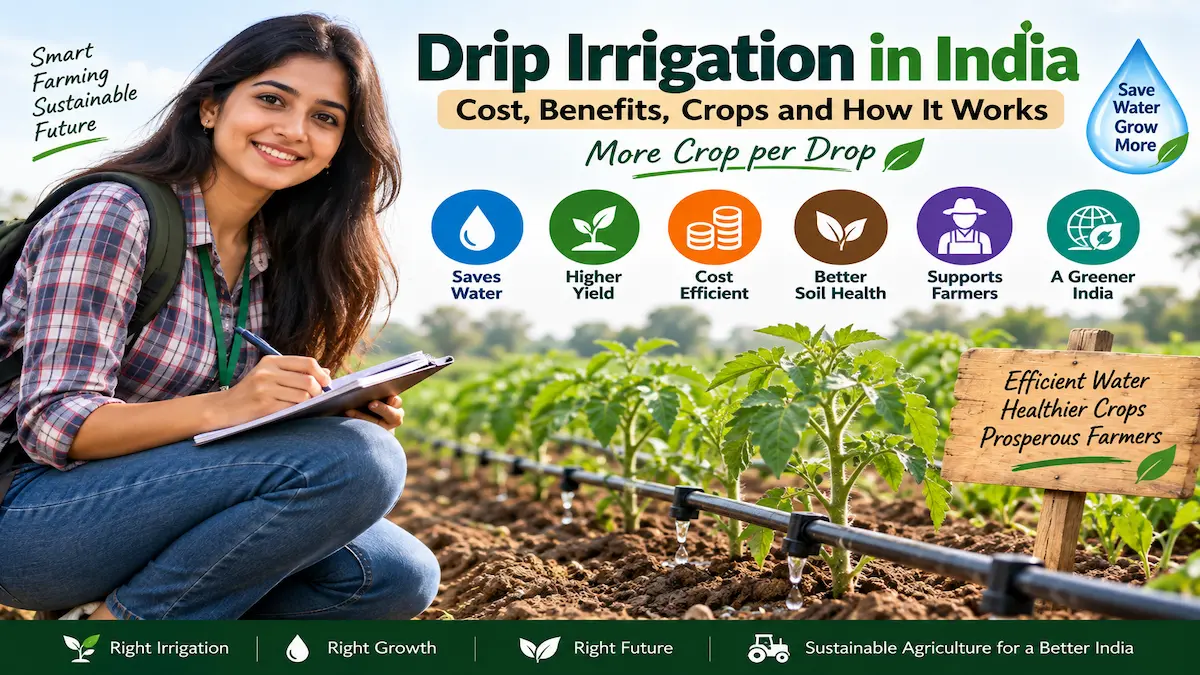
With drip irrigation, a lateral pipe is placed along the crop row and small emitters release water near each plant.
The objective is to put water where the crop needs it, when it needs it.
How Does Drip Irrigation Work?
The basic process is straightforward.
Step 1: Water enters the system
Water comes from a source such as:
- Borewell
- Open well
- Farm pond
- Reservoir
- Water storage tank
- Other suitable sources
Step 2: Filtration
Water passes through filters before entering the distribution network.
Filtration is extremely important because suspended particles can clog small emitters.
Step 3: Water moves through pipes
The filtered water travels through the main pipe and then through smaller sub-main pipes and lateral lines.
Step 4: Emitters release water
Small emitters installed along the lateral pipes release water at a controlled rate.
Step 5: Water reaches the root zone
The water gradually enters the soil near the crop roots.
This creates a relatively localized wetting zone around the root area rather than wetting the entire field surface.
Why Is Drip Irrigation Important in India?
India has many different agricultural regions, from areas with relatively abundant rainfall to dry and semi-arid regions where irrigation water is limited.
Drip irrigation can be particularly useful where farmers need to make better use of available water.
It can help address several common agricultural challenges:
- Limited irrigation water
- Uneven water distribution
- Water loss from open channels
- Increasing irrigation costs
- Labour requirements for irrigation
- Need for precise crop management
However, drip irrigation is not a universal solution. Good system design, appropriate crop selection, filtration and regular maintenance are essential.
Major Benefits of Drip Irrigation
1. More Efficient Use of Water
One of the biggest advantages of drip irrigation is that water can be delivered close to the plant’s root zone.
This can reduce unnecessary wetting of areas where crops are not growing.
The actual water saving depends on factors such as:
- Crop
- Soil type
- Climate
- Existing irrigation method
- System design
- Management practices
Therefore, farmers should not assume that every drip system will produce the same percentage of water savings.
2. Reduced Water Loss
In appropriately designed systems, drip irrigation can reduce losses associated with surface application and excessive evaporation from exposed soil.
Because water is delivered in a controlled manner, farmers can adjust irrigation according to crop requirements.
3. Better Fertilizer Management
Drip systems can be used with fertigation, where soluble fertilizers are supplied through irrigation water.
This can allow nutrients to be delivered closer to the active root zone.
However, fertilizers should only be injected when the system and fertilizer are compatible, and appropriate filtration and flushing practices should be followed.
4. Improved Weed Management
Since the entire field surface does not necessarily receive the same amount of water, areas between crop rows may remain relatively drier.
This can reduce favourable conditions for some weeds.
It does not, however, eliminate weeds completely.
5. Reduced Soil Erosion
Because water is applied slowly rather than released in large quantities over the field, drip irrigation can help reduce certain forms of soil erosion associated with excessive surface water movement.
6. Less Waterlogging in Suitable Conditions
Carefully controlled irrigation can reduce the risk of applying more water than the crop needs.
But this depends heavily on soil type, drainage and irrigation scheduling. Poorly managed drip irrigation can still lead to excessive moisture.
7. Potential Labour Savings
Once properly installed, a drip system can reduce some manual irrigation work.
Farmers can use valves, timers and other controls to manage irrigation more systematically.
8. Suitable for Fertigation
One major advantage of drip irrigation is its compatibility with fertigation.
Instead of applying all fertilizer separately, suitable soluble nutrients can be supplied through the irrigation system.
This can improve the precision of nutrient application when properly managed.
Which Crops Are Suitable for Drip Irrigation?
Drip irrigation can be particularly useful for crops where plants are arranged in rows or have defined root zones.
Vegetables
Examples include:
- Tomato
- Chilli
- Capsicum
- Cucumber
- Brinjal
- Okra
- Cauliflower
- Cabbage
- Melons
Fruits
Drip irrigation is widely applicable to orchards and fruit crops such as:
- Grapes
- Pomegranate
- Banana
- Papaya
- Citrus
- Mango
- Guava
Plantation and commercial crops
Depending on local conditions, drip systems may also be used for:
- Sugarcane
- Cotton
- Certain plantation crops
- Spices
- Other high-value crops
Field crops
Some field crops can also be grown using drip irrigation, particularly where water availability is limited and the economics justify the system.
The best design depends on crop spacing, soil, water availability and farming practices.
Drip Irrigation for Different Soil Types
The same irrigation schedule does not work equally well in every soil.
Sandy soil
Sandy soils drain water relatively quickly. Irrigation may therefore need to be applied in smaller amounts at more frequent intervals.
Clay soil
Clay soils can hold more water but may have slower infiltration. Applying water too quickly can create excessive moisture.
Loamy soil
Loamy soils often provide a useful balance between water retention and drainage, although actual irrigation requirements still depend on the crop and local conditions.
The goal is not simply to run the drip system for a fixed number of hours. The irrigation schedule should be based on crop demand, soil moisture and weather conditions.
How Much Does Drip Irrigation Cost in India?
There is no single fixed price for installing drip irrigation in India.
The cost can vary considerably depending on:
- Farm size
- Crop
- Plant spacing
- Quality of pipes and emitters
- Water source
- Pump requirements
- Filtration system
- Automation
- Terrain
- Labour and installation costs
- Local market prices
For this reason, giving one nationwide per-acre price can be misleading.
Typical cost components
A farmer’s quotation may include:
| Component | Purpose |
|---|---|
| Main pipe | Carries water from the source |
| Sub-main | Distributes water to sections |
| Laterals | Carry water along crop rows |
| Emitters | Deliver controlled water |
| Filters | Prevent clogging |
| Valves | Control sections of the field |
| Pressure equipment | Maintain suitable pressure |
| Fertigation unit | Allows suitable fertilizers to be applied |
| Installation | Laying and connecting the system |
Farmers should obtain a site-specific quotation from an authorised or reliable supplier before making a purchase.
Is There a Government Subsidy for Drip Irrigation?
Yes, government programmes in India have supported micro-irrigation, including drip and sprinkler systems.
Support has been associated with programmes such as Pradhan Mantri Krishi Sinchayee Yojana (PMKSY) and its micro-irrigation components, with implementation involving state governments.
However, farmers should be careful about relying on old subsidy figures found online.
Why?
Subsidy:
- Can differ by state
- Can depend on farmer category
- Can depend on crop and system
- Can have area limits
- Can change under revised government guidelines
- May be implemented through state departments or designated agencies
Therefore, farmers should check the latest rules with their State Agriculture/Horticulture Department or official micro-irrigation portal before purchasing equipment.
Important advice
Do not purchase a system solely because a seller promises a particular subsidy.
First confirm:
- Whether you are eligible.
- Whether your crop and area qualify.
- Whether the supplier is authorised under the applicable programme.
- What documents are required.
- Whether approval is required before installation.
- What the current assistance limits are.
What Is Fertigation?
Fertigation combines fertilization and irrigation.
A suitable fertilizer can be dissolved and introduced into the irrigation system so that nutrients are distributed with irrigation water.
For example, a farmer growing vegetables may divide fertilizer applications into smaller doses rather than applying everything at once.
Potential advantages
- More precise nutrient application
- Better timing of nutrients
- Reduced manual fertilizer application
- Efficient use of suitable soluble fertilizers
But fertigation requires proper knowledge. Not every fertilizer should be put into a drip system.
Incompatible products can cause precipitation and clogging.
Maintenance of a Drip Irrigation System
Buying and installing a drip system is only the beginning.
Regular maintenance is essential.
1. Clean the filters
Filters should be inspected and cleaned according to water quality and manufacturer’s recommendations.
2. Check emitters
Blocked or damaged emitters can result in uneven irrigation.
3. Flush the pipes
Periodic flushing helps remove accumulated particles and deposits.
4. Inspect for leaks
Damaged pipes can waste water and reduce pressure elsewhere in the field.
5. Monitor pressure
Incorrect pressure can affect the uniformity of water delivery.
6. Protect the system from physical damage
Farm machinery, animals and field operations can damage exposed pipes.
Remember:
A poorly maintained drip system can perform far below its potential.
Common Problems With Drip Irrigation
Although drip irrigation has many advantages, farmers should also understand its limitations.
Emitter clogging
This is one of the most common problems.
Possible causes include:
- Dirt
- Sand
- Algae
- Mineral deposits
- Incompatible fertilizers
Good filtration and maintenance are therefore essential.
Initial installation cost
The initial investment can be higher than some conventional irrigation arrangements.
Technical knowledge
Farmers need to understand:
- Irrigation scheduling
- Filter maintenance
- Pressure
- Fertigation
- Pipe flushing
Damage to pipes
Rodents, farm equipment and other physical factors can damage components.
Poor system design
If laterals, emitters, filtration or pressure are incorrectly selected, irrigation may be uneven.
Drip Irrigation vs Traditional Irrigation
| Feature | Drip Irrigation | Conventional Surface Irrigation |
|---|---|---|
| Water delivery | Near root zone | Across/along field |
| Water control | High | Usually lower |
| Initial investment | Higher | Often lower |
| Maintenance | Regular maintenance required | Generally simpler |
| Fertigation | Possible | Less precise |
| Weed wetting | Can be reduced | Often greater |
| Suitable crops | Many row crops and orchards | Wide range |
| Automation | Relatively easy | More difficult in many systems |
The choice should be based on water availability, crop economics, soil, farm size and local conditions.
How Farmers Can Improve Drip Irrigation Performance
Farmers can get better results by following a few basic principles.
Use good-quality filtration
Water quality should be assessed before selecting the filtration system.
Divide the field into irrigation zones
Large fields can be divided into sections so that irrigation can be managed according to pressure and crop requirements.
Avoid over-irrigation
Drip irrigation does not mean that more water will produce more yield.
Excessive irrigation can waste water and may create root-zone problems.
Check uniformity
Farmers should periodically check whether emitters are delivering water relatively uniformly across the field.
Combine irrigation with crop monitoring
Weather, soil moisture and crop growth should influence irrigation decisions.
Is Drip Irrigation Worth It for Small Farmers?
It can be, but the answer depends on the economics.
Farmers should consider:
- Crop value
- Available water
- Farm size
- Existing irrigation infrastructure
- Expected productivity benefits
- Labour savings
- System lifespan
- Maintenance costs
- Available government assistance
For high-value crops such as vegetables, fruits and certain commercial crops, the economics may be more attractive.
For low-value crops, the farmer should carefully calculate the investment and expected return before installing the system.
A Simple Example
Suppose a farmer has a small vegetable field and currently irrigates it manually.
The farmer could compare:
Current system
Water + labour + pumping cost + time
versus
Drip system
Installation + filtration + maintenance + pumping + replacement costs
The farmer can then compare these costs with the expected benefits from:
- Better water management
- Possible yield improvement
- Reduced labour
- Fertigation
- Potential reduction in input losses
This is a much better approach than assuming that drip irrigation is automatically profitable.
Frequently Asked Questions
Does drip irrigation save water?
It can significantly improve irrigation efficiency and reduce certain water losses when properly designed and managed. The actual saving varies according to crop, soil, climate, existing irrigation method and management.
Which crops benefit most from drip irrigation?
Vegetables, fruit orchards, grapes, pomegranate, banana, sugarcane and several other row or high-value crops can be suitable. The exact suitability depends on local conditions.
Is drip irrigation expensive?
The initial cost can be higher than some traditional irrigation systems. However, the overall economics should include potential water, labour, fertilizer and productivity benefits.
Can drip irrigation be used for organic farming?
Yes. Drip irrigation can be used in organic farming. However, fertilizers and other inputs must comply with the applicable organic farming standards.
How often should drip irrigation be used?
There is no universal schedule. Frequency depends on crop growth stage, soil, weather, evapotranspiration, rainfall and system design.
Does drip irrigation eliminate the need for rain?
No. Drip irrigation is a method of supplying irrigation water. Rainfall remains an important source of water for many farming systems.
Can farmers get government assistance for drip irrigation?
Micro-irrigation has been supported through government programmes, but eligibility and assistance vary. Farmers should verify current state-specific rules before purchasing equipment.
Conclusion
Drip irrigation can be an important tool for water-efficient agriculture in India. Instead of distributing large quantities of water across an entire field, it allows farmers to deliver controlled amounts closer to the crop’s root zone.
Its advantages can include improved water management, compatibility with fertigation, reduced unnecessary wetting, lower irrigation labour and better control over crop irrigation.
But drip irrigation is not simply a matter of installing pipes. The system must be correctly designed for the crop and field, properly filtered, regularly maintained and operated according to actual crop water requirements.
For farmers considering an investment, the best approach is to compare the total installation and maintenance cost with the expected benefits for their particular crop and location. Government assistance may reduce the initial financial burden where the farmer qualifies, but current state-specific rules should always be verified through official channels.
With appropriate design and management, drip irrigation can contribute to a more efficient and sustainable approach to farming—particularly in areas where every drop of water matters.
For the published version on WorldAgriculture.in, I recommend linking readers to official sources rather than third-party subsidy websites:
- PMKSY: https://pmksy.gov.in
- Micro Irrigation / State Agriculture Department: Check the official agriculture portal of the relevant state.
Editor’s note: Government assistance, eligibility criteria and programme guidelines can change. Readers should verify the latest information with the appropriate government department before purchasing equipment or applying for financial assistance.