India’s agriculture sector supports millions of farming families and plays an important role in the country’s food security and rural economy. Yet farmers regularly face challenges such as unpredictable weather, rising input costs, limited access to credit, water shortages, crop losses and difficulties in finding remunerative markets.
To address these challenges, the Government of India and state governments run a wide range of agricultural schemes. These programmes cover different stages of farming—from buying inputs and obtaining credit to protecting crops against weather-related losses, improving irrigation, storing produce and adopting modern technology.
However, knowing that a scheme exists is not enough. Farmers also need to understand who can benefit, what kind of assistance is available, where to apply and what documents may be required.
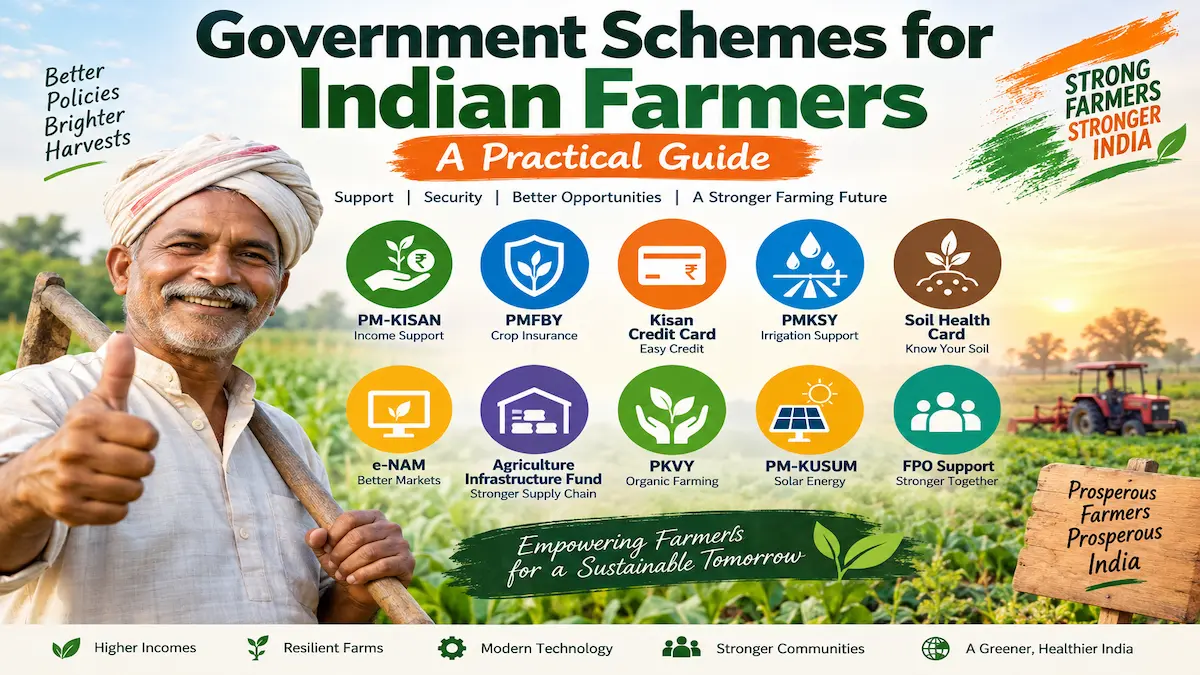
This practical guide explains some of the major central government initiatives relevant to Indian farmers and how they fit into different farming needs.
Important: Scheme eligibility, application procedures, assistance amounts and state-level implementation can change. Farmers should verify the latest details through the relevant official government portal or agriculture department before applying.
1. PM-KISAN: Income Support for Eligible Farmer Families
The Pradhan Mantri Kisan Samman Nidhi (PM-KISAN) is one of India’s best-known farmer support programmes.
The scheme provides income support to eligible landholding farmer families, subject to the scheme’s eligibility and exclusion conditions. The assistance is transferred directly to eligible beneficiaries through the Direct Benefit Transfer (DBT) system.
What is PM-KISAN useful for?
The support can help farming households meet some of their agricultural and household financial requirements, such as:
- Seeds and other farm inputs
- Fertilizers
- Small agricultural expenses
- Other household needs
How can farmers check their status?
Farmers can use the official PM-KISAN portal to check beneficiary and payment-related information.
Official website:
https://pmkisan.gov.in/
Farmers should keep their land and identification records updated and complete any required e-KYC process.
2. Pradhan Mantri Fasal Bima Yojana (PMFBY)
Farming is highly dependent on weather. Droughts, floods, cyclones, excessive rainfall, pests and diseases can cause serious crop losses.
The Pradhan Mantri Fasal Bima Yojana (PMFBY) provides crop insurance coverage against specified risks, subject to the applicable scheme and state-level provisions.
Why is crop insurance important?
Crop insurance can reduce the financial shock caused by crop failure. Instead of bearing the entire eligible loss alone, an insured farmer may receive compensation according to the terms and assessment procedures of the scheme.
Coverage and notified crops can vary by state and season.
Farmers should remember
Before taking crop insurance, check:
- Whether the crop is notified in your area
- The applicable insurance period
- The relevant premium
- Covered risks
- Cut-off dates
- Claim procedure
Official website:
https://pmfby.gov.in/
3. Kisan Credit Card (KCC): Easier Access to Agricultural Credit
Farmers often need money before receiving income from their crops. They may need funds for seeds, fertilizers, pesticides, labour, irrigation or other agricultural activities.
The Kisan Credit Card (KCC) system was introduced to make institutional agricultural credit more accessible.
Eligible farmers can approach participating banks and financial institutions for KCC facilities, subject to applicable lending rules.
KCC can help with
Depending on the sanctioned facility, agricultural credit may support:
- Crop cultivation expenses
- Working capital requirements
- Certain allied agricultural activities
- Post-harvest requirements
Farmers should ask their bank about current interest rates, applicable concessions, limits, collateral requirements and repayment conditions.
Practical tip:
Do not wait until the sowing season is already underway. Farmers who require seasonal credit should contact their bank well in advance.
4. Pradhan Mantri Krishi Sinchayee Yojana (PMKSY)
Water availability is one of the biggest challenges facing Indian agriculture.
The Pradhan Mantri Krishi Sinchayee Yojana (PMKSY) focuses on improving irrigation coverage and encouraging more efficient use of water.
One of its important objectives is the idea of “Per Drop More Crop”, which promotes efficient irrigation methods such as micro-irrigation.
Why does micro-irrigation matter?
Methods such as:
- Drip irrigation
- Sprinkler irrigation
can help deliver water more efficiently when appropriately designed and managed.
The actual assistance available to an individual farmer depends on the relevant component and state implementation.
Farmers interested in irrigation support should contact their State Agriculture/Horticulture Department or the designated implementing agency.
5. Soil Health Card Scheme
Good farming begins with healthy soil.
Applying fertilizers without understanding soil conditions can lead to inefficient nutrient use. The Soil Health Card Scheme promotes soil testing and provides farmers with information about important soil characteristics and nutrient status.
A soil test can help farmers understand parameters such as:
- Soil pH
- Organic carbon
- Major nutrients
- Other relevant soil properties
Why should farmers test their soil?
A soil test can help answer an important question:
“What does my soil actually need?”
Instead of following the same fertilizer practice every season, farmers can use soil information to make more informed nutrient-management decisions.
This can potentially improve fertilizer efficiency and support long-term soil health.
6. e-NAM: Connecting Agricultural Markets Digitally
Selling agricultural produce at a fair price is as important as producing it.
The National Agriculture Market (e-NAM) is an electronic trading platform designed to connect agricultural markets and improve transparency in agricultural commodity trading.
It aims to create a more integrated agricultural market by using technology.
Potential advantages include
- Better price discovery
- Greater market transparency
- Digital trading facilities
- Wider access to buyers
- Reduction of information gaps
However, farmers should understand that the availability of facilities and trading arrangements depends on the relevant market and commodity.
7. Agriculture Infrastructure Fund (AIF)
A major problem in agriculture is what happens after harvesting.
Without adequate storage, grading, processing and logistics facilities, farmers may be forced to sell produce quickly.
The Agriculture Infrastructure Fund (AIF) is intended to support investment in agricultural infrastructure and related projects.
The programme can be relevant to eligible projects involving areas such as:
- Warehousing
- Cold storage
- Post-harvest management
- Processing infrastructure
- Community farming assets
- Other eligible agricultural infrastructure
AIF is not simply a direct cash-payment scheme for every farmer. Its relevance is particularly strong for eligible entrepreneurs, farmer groups, cooperatives, FPOs and other permitted entities developing agricultural infrastructure.
8. Paramparagat Krishi Vikas Yojana (PKVY)
Farmers interested in organic and sustainable farming can explore support available under the Paramparagat Krishi Vikas Yojana (PKVY) and related government programmes.
The approach promotes practices associated with:
- Organic farming
- Reduced dependence on synthetic agricultural inputs
- Soil health
- Sustainable production
- Group-based farming approaches
Farmers should check the latest guidelines and state-level implementation before assuming that a particular input or financial benefit is covered.
Energy costs and unreliable electricity can create difficulties for farmers, particularly where irrigation depends on pumps.
The Pradhan Mantri Kisan Urja Suraksha evam Utthaan Mahabhiyan (PM-KUSUM) promotes the use of solar energy in the agricultural sector.
Its different components cover areas such as:
- Solar power plants
- Standalone solar agricultural pumps
- Solarisation of existing agricultural pumps
The programme can potentially help reduce dependence on conventional electricity or diesel for eligible applications.
An important point
The exact subsidy structure and implementation arrangements can vary. Farmers should apply only through the designated government agencies and verify the latest state-specific rules.
10. National Mission for Sustainable Agriculture (NMSA)
Indian agriculture has to become more resilient to changing climatic conditions.
The National Mission for Sustainable Agriculture (NMSA) is associated with promoting more sustainable and climate-resilient agricultural practices.
The broader approach includes areas such as:
- Water-use efficiency
- Soil health management
- Sustainable agricultural practices
- Resource conservation
- Climate-resilient farming
This is increasingly important as farmers deal with changing rainfall patterns, heat stress and other climate-related risks.
11. Support for Farmer Producer Organisations (FPOs)
Small farmers can face difficulties when purchasing inputs or selling produce individually.
A Farmer Producer Organisation (FPO) allows farmers to work collectively and can improve their bargaining position and access to services.
Government initiatives have supported the formation and strengthening of FPOs.
Why can an FPO be useful?
A well-managed FPO can potentially help farmers with:
- Bulk purchase of inputs
- Collective marketing
- Storage
- Processing
- Better access to markets
- Technical assistance
- Negotiating power
But an FPO is not automatically successful simply because it has been registered. Good management, transparent accounting, market connections and active farmer participation are essential.
12. How Farmers Should Choose the Right Government Scheme
There is no single government scheme that is suitable for every farmer.
A better approach is to identify the problem first.
| Farmer’s need | Scheme/programme to explore |
|---|---|
| Income support | PM-KISAN |
| Protection against notified crop risks | PMFBY |
| Agricultural credit | Kisan Credit Card |
| Irrigation efficiency | PMKSY / micro-irrigation programmes |
| Understanding soil nutrients | Soil Health Card |
| Better agricultural markets | e-NAM |
| Post-harvest infrastructure | Agriculture Infrastructure Fund |
| Organic farming | PKVY and related programmes |
| Solar agricultural energy | PM-KUSUM |
| Collective farming and marketing | FPO-related programmes |
This table is only a starting point. Eligibility and availability must be checked for the farmer’s state, crop and individual circumstances.
Documents Farmers May Commonly Need
The exact requirements differ between schemes, but farmers may be asked for documents or information such as:
- Aadhaar or another accepted identity document
- Mobile number
- Bank account details
- Land ownership/land-record information
- Cultivation or crop details
- Passport-size photograph, where applicable
- Address details
- Caste/category certificate, where applicable
- Other documents specified by the implementing department
Keeping land records, bank details and mobile number updated can make applications easier.
Where Should Farmers Apply?
Farmers should be careful about unofficial websites and agents promising guaranteed government benefits.
Depending on the scheme, applications or information may be available through:
Central government portals
PM-KISAN:
https://pmkisan.gov.in/
PMFBY:
https://pmfby.gov.in/
Other sources
Farmers can also contact:
- State Agriculture Department
- District Agriculture Office
- Krishi Vigyan Kendra (KVK)
- Agricultural extension officers
- Participating banks
- Common Service Centres (CSCs)
- Official government portals
Always verify the latest scheme guidelines before paying anyone or submitting sensitive information.
Common Mistakes Farmers Should Avoid
Government schemes can be useful, but farmers sometimes miss benefits because of simple administrative problems.
1. Assuming every scheme applies to everyone
Many schemes have specific eligibility conditions.
2. Ignoring deadlines
Crop insurance and other seasonal programmes can have strict timelines.
3. Using incorrect bank details
DBT-related benefits depend on correctly linked and valid banking information.
4. Not updating land records
Land-related eligibility is important for several agricultural programmes.
5. Relying on social-media messages
A WhatsApp message or YouTube video may contain outdated information.
Always confirm the information through an official government source.
6. Paying unofficial agents
Farmers should be cautious about anyone claiming they can guarantee a government benefit in exchange for money.
How Technology Is Changing Access to Agricultural Schemes
Technology is gradually changing how farmers interact with government programmes.
Digital platforms can help with:
- Registration
- Beneficiary verification
- Application tracking
- DBT payments
- Crop insurance information
- Market information
- Land-record verification
- Agricultural advisories
However, digital access should not become a barrier for farmers who are less comfortable with smartphones or online applications. Local agriculture offices, CSCs and extension services can play an important role in helping farmers.
What Farmers Should Do Before Applying
Before applying for any government agricultural scheme, follow these five steps:
Step 1: Identify the exact problem you want to solve.
Step 2: Check whether the scheme is available in your state and for your crop/activity.
Step 3: Read the current eligibility conditions.
Step 4: Keep identity, bank and land-related documents ready.
Step 5: Apply through the official portal or authorised department and keep the acknowledgement/application number.
This simple process can prevent many avoidable problems.
A farmer’s needs rarely fit into a single government programme.
For example, a farmer may need:
soil testing → quality seed → agricultural credit → efficient irrigation → crop insurance → better market access → storage
Different programmes can potentially address different parts of this chain.
The real benefit therefore comes from understanding which support is relevant at each stage of farming, rather than searching for a single scheme that promises everything.
Frequently Asked Questions
Which is the most important government scheme for farmers in India?
There is no single “best” scheme for every farmer. PM-KISAN, PMFBY, KCC, PMKSY, e-NAM and other programmes address different needs such as income support, insurance, credit, irrigation and marketing.
Can a farmer benefit from more than one government scheme?
In many cases, yes, provided the farmer or project independently meets the eligibility conditions of each programme. One scheme’s eligibility should not automatically be assumed to guarantee eligibility for another.
Where can farmers find authentic scheme information?
The safest sources are official government portals, State Agriculture Departments, district agricultural offices, KVKs, participating banks and authorised service centres.
Are all government schemes available in every state?
No. Some programmes have state-specific implementation, notified crops, components or eligibility conditions. Always check the rules applicable to your state.
Can tenant farmers benefit from government schemes?
Eligibility varies considerably between schemes. Some programmes may have requirements related to land records or cultivation status. Farmers who cultivate leased land should check the specific scheme guidelines rather than assuming eligibility.
Conclusion
Government agricultural schemes can provide valuable support to Indian farmers, but their usefulness depends on choosing the right programme for the right need.
PM-KISAN can provide income support to eligible farmer families, crop insurance can help manage specified agricultural risks, KCC can provide access to institutional credit, irrigation programmes can encourage efficient water use, soil testing can improve nutrient management, e-NAM can support market integration, while infrastructure and renewable-energy programmes can help agriculture become more efficient and resilient.
The most important lesson is simple:
Don’t apply for a scheme merely because you heard about it. First identify your farming need, check the latest eligibility rules, and use the official government channel to apply.
Agricultural policies and scheme guidelines can change over time, so farmers should always verify the latest information from the concerned government department or official portal before making financial or farming decisions.