


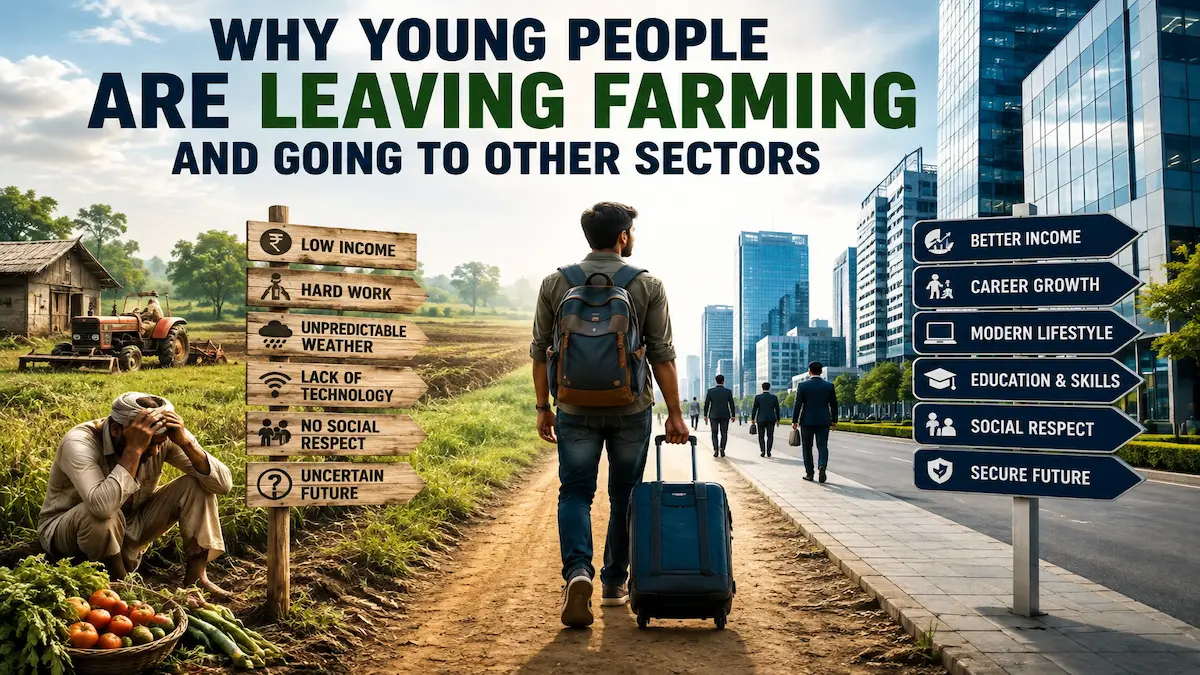
For generations, farming has been at the heart of rural India. It has provided food, employment and a way of life for millions of families. Yet a major change is taking place across rural communities: many children of farmers are choosing careers outside agriculture.
They are becoming engineers, teachers, doctors, government employees, bankers, entrepreneurs, IT professionals and skilled workers. Others are moving to cities in search of better opportunities.
Why is this happening?
The answer is not simply that young people do not respect farming or are unwilling to work hard. In many cases, they understand farming better than anyone because they have grown up watching their parents do it. They have seen the hard work, uncertainty and financial risks involved.
For many young people, leaving agriculture is therefore not a rejection of their roots. It is a search for stability, dignity, independence and a better future.
1. Uncertain and Unpredictable Income
One of the biggest challenges of farming is income uncertainty.
Farmers have to spend money on seeds, fertilizers, pesticides, irrigation, labour, machinery and transportation before they earn anything from a crop. Even after making these investments, the final income remains uncertain.
Weather can damage production, while a good harvest can sometimes result in lower market prices because of increased supply.
A salaried employee generally knows what they will earn each month. A farmer does not have the same certainty.
Young people who have watched their parents struggle with this uncertainty may naturally prefer careers offering regular salaries and more predictable financial planning.
2. Rising Costs and Small Landholdings
Modern agriculture often requires significant investment. At the same time, agricultural land in many families is divided among successive generations.
A farm that once supported one family may eventually have to support several households.
This creates a difficult question for the next generation: Can the available land provide a satisfactory livelihood for everyone?
For many young people, education offers an alternative. A professional qualification can provide an opportunity to earn independently without depending entirely on the family’s limited agricultural land.
3. Education Has Expanded Aspirations
Education has perhaps been the most powerful force changing rural India.
Today’s rural students have access to schools, colleges, smartphones, the internet, online courses and information about careers across the country. They can see people from similar backgrounds becoming doctors, civil servants, engineers, entrepreneurs and technology professionals.
Education does not necessarily make young people dislike agriculture.
It gives them more choices.
And when young people have more choices, they may choose a profession different from the one followed by their parents.
4. Parents Often Encourage Their Children to Leave Farming
There is an important irony in this situation.
Many farmers themselves encourage their children to pursue other careers.
After spending decades dealing with uncertain income, physical labour and agricultural risks, parents may tell their children:
“Study well and get a good job. Don’t struggle like we did.”
Thus, the movement away from agriculture is not always driven by young people. Sometimes parents actively encourage it because they believe education can provide their children with a more secure life.
5. Social Status Matters
Career choices are influenced by social expectations as well as income.
Government jobs, medicine, engineering, banking, corporate employment and other professional careers are often associated with education, social status and upward mobility.
Farming, despite being essential to society, does not always receive the same level of recognition.
This creates a contradiction: India depends on farmers for food, but farming is not always seen as an aspirational profession.
Young people may therefore feel that a professional career will bring greater respect and recognition.
6. Farming Is Physically Demanding and Risky
Agriculture requires hard physical work, often under difficult conditions.
Farmers may work in extreme heat, rain and long hours during sowing and harvesting seasons. They must also constantly deal with pests, diseases, water shortages and changing weather.
Young people growing up in farming households see these challenges firsthand.
At the same time, they are exposed to careers that may offer more predictable working hours and working environments.
This comparison naturally affects their choices.
7. Climate and Environmental Uncertainty
Agriculture is closely connected to nature.
Changes in rainfall, temperature, water availability, extreme weather and pest patterns can affect farm production.
For young people thinking about their future 20 or 30 years from now, climate-related uncertainty can make agriculture appear even riskier.
They may feel more comfortable choosing a career where their income is less directly dependent on environmental conditions.
8. Better Opportunities Outside the Village
India’s economic development has created employment opportunities in manufacturing, construction, logistics, healthcare, education, retail, banking, technology, hospitality and many other sectors.
For rural youth, migration to towns and cities can open doors to education and employment.
Once a young person builds a career outside agriculture, develops professional relationships and establishes an urban lifestyle, returning to farming can become increasingly difficult and less attractive.
9. Agriculture Is Often Seen as Traditional Rather Than Entrepreneurial
Another important issue is how agriculture is presented.
A young person may hear:
“You will inherit the farm, so you should become a farmer.”
But modern agriculture can be much more than simply cultivating land.
It can involve precision farming, protected cultivation, drones, digital technology, food processing, direct marketing, agricultural machinery, storage, logistics, exports and agritourism.
The challenge is that many young people do not see agriculture as a modern business.
They see it as working in the field, rather than running an agricultural enterprise.
Changing this perception could make a major difference.
10. Young People Want Control Over Their Future
Perhaps the deeper issue is control.
A young person may believe that if they study, acquire skills and perform well in a profession, they can influence their career and income.
Farming is different. Even if a farmer makes good decisions, weather and market conditions can still change the outcome.
This uncertainty can make alternative careers more attractive.
What Can Be Done?
The answer should not be to force farmers’ children to remain in agriculture.
Instead, agriculture needs to become a genuine and attractive career option.
This requires:
- Better market access
- Modern technology
- Improved irrigation
- Affordable credit
- Better storage and processing
- Agricultural education
- Professional farm management
- Stronger rural infrastructure
- Opportunities for agricultural entrepreneurship
- Better access to reliable market and weather information
Most importantly, young people need to see agriculture as a business and career, not merely as a family tradition.
A farmer’s child does not have to choose between traditional farming and leaving agriculture completely.
They could become an agricultural entrepreneur, food processor, agri-tech professional, machinery-service provider, marketer, exporter or farm-business owner.
Conclusion
The children of Indian farmers are not necessarily leaving agriculture because they are lazy or disconnected from their roots.
They are often making a rational decision based on what they have experienced.
They have watched their parents work extremely hard while facing unpredictable income, rising costs, weather risks and uncertain markets. At the same time, education and technology have exposed them to many alternative careers.
The solution is therefore not to criticize young people for leaving farming.
It is to ask a more important question:
Why doesn’t agriculture provide enough young people with a future they want?
India does not need to force every farmer’s child to become a farmer. Young people should have the freedom to choose their careers.
But agriculture should be transformed so that those who genuinely want to stay can see a future of profitability, dignity, innovation and growth.
The future of Indian agriculture may depend not on keeping every young person on the farm, but on making farming modern and successful enough that the next generation chooses it willingly.