


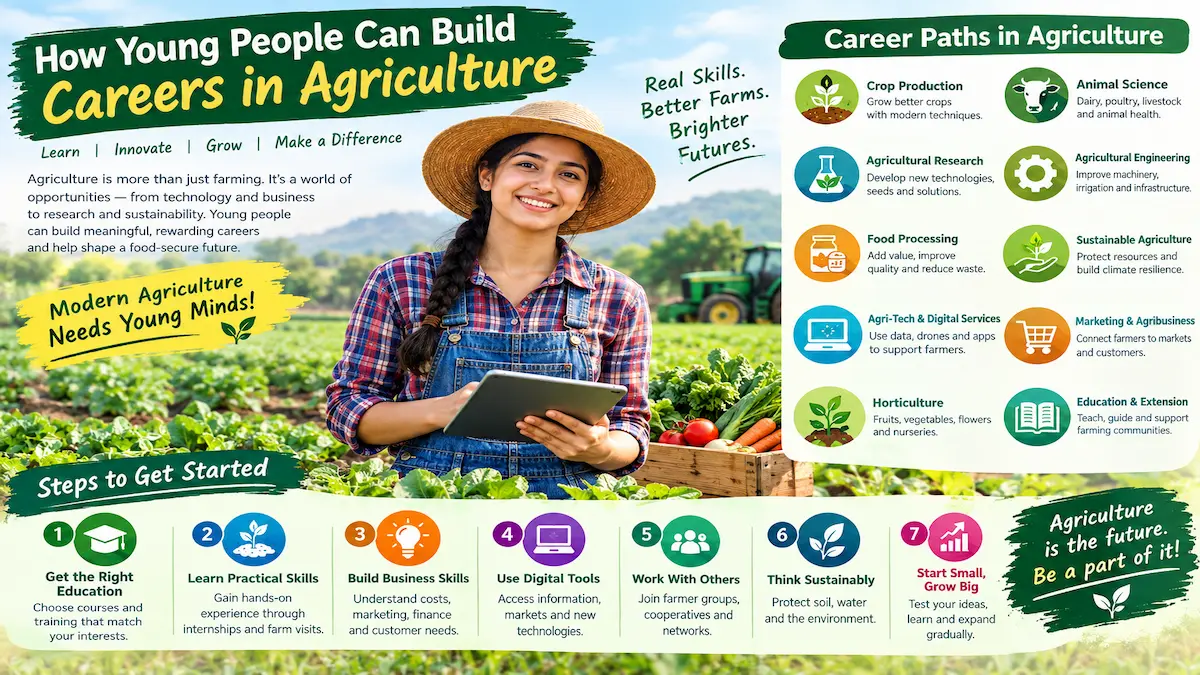
Agriculture is often viewed as a traditional profession, but the modern agricultural sector is changing rapidly. New technologies, changing consumer preferences, climate challenges, food processing, digital platforms, and growing demand for quality food are creating exciting career opportunities for young people.
For generations, farming has been associated mainly with growing crops and raising livestock. Today, agriculture is much broader. It includes agribusiness, agricultural technology, food processing, marketing, logistics, farm management, research, finance, digital services, and sustainable agriculture. This means young people do not have to own a large farm to build a successful career in the sector.
With the right skills, education, creativity, and willingness to learn, agriculture can provide meaningful employment and entrepreneurship opportunities.
Agriculture Is Becoming More Technology-Driven
One of the biggest changes in agriculture is the growing use of technology. Farmers are increasingly using smartphones, satellite information, weather forecasts, sensors, drones, irrigation systems, farm-management software, and digital marketplaces to make better decisions.
This creates opportunities for young people who are comfortable with technology. Someone with knowledge of computers, mobile applications, data analysis, or digital marketing can provide valuable services to farmers.
For example, young entrepreneurs can help farmers monitor crops, access weather information, maintain digital records, market their produce online, or connect with buyers. Drone-based crop monitoring and precision agriculture are also creating new areas of work for trained professionals.
Technology does not replace farmers. Instead, it gives them better tools to manage their farms and improve productivity.
Learn the Basics of Farming
Young people interested in agriculture should begin by understanding the fundamentals. Even if the goal is to work in agribusiness or agricultural technology, practical knowledge of farming is extremely valuable.
Learning about soil, seeds, irrigation, crop nutrition, pests, diseases, harvesting, storage, and farm economics provides a strong foundation. Young people can gain this knowledge through agricultural schools and colleges, vocational courses, training programmes, online learning, internships, or practical experience on farms.
Spending time with experienced farmers can also be highly educational. Farmers have valuable practical knowledge about local soils, weather conditions, crops, markets, and common production challenges.
Combining traditional knowledge with modern scientific information can help young professionals develop practical solutions.
Explore Agriculture-Related Education
A career in agriculture does not necessarily require one specific degree. Young people can choose education according to their interests.
Agricultural science can lead to careers in crop production, soil management, plant protection, research, and extension services. Horticulture offers opportunities involving fruits, vegetables, flowers, nurseries, and landscaping. Animal science can lead to careers in dairy, poultry, livestock, and animal health.
Other fields such as agricultural engineering, food technology, biotechnology, environmental science, business management, economics, and information technology can also be connected to agriculture.
Short-term vocational courses can be useful for people who want practical skills quickly. Areas such as food processing, organic farming, beekeeping, mushroom production, nursery management, farm machinery, irrigation, and digital agriculture can provide pathways into employment or self-employment.
Start an Agricultural Business
Entrepreneurship is one of the most promising opportunities for young people in agriculture. A successful agricultural business does not necessarily require a large piece of land.
Young entrepreneurs can explore enterprises such as vegetable production, nurseries, mushroom cultivation, beekeeping, poultry, dairy, fish farming, seedling production, composting, food processing, or farm-input services.
The key is to identify a genuine local need.
For example, if farmers in an area struggle to find healthy seedlings, a young person could establish a nursery. If local farmers have difficulty accessing markets, a business could focus on aggregation, packaging, and marketing. If agricultural waste is abundant, it could potentially be converted into compost or other useful products.
Starting small allows entrepreneurs to test their idea, learn from customers, manage risks, and expand gradually.
Learn Business and Marketing Skills
Good agricultural production alone does not guarantee a profitable enterprise. Young people also need business skills.
Understanding costs, pricing, budgeting, record keeping, customer service, branding, and marketing can make a major difference. Farmers and agricultural entrepreneurs should know how much they spend, how much they earn, and which activities generate the best returns.
Digital marketing can be particularly useful. Social media, messaging platforms, websites, and online marketplaces can help agricultural businesses reach customers beyond their immediate communities.
A young farmer who produces high-quality vegetables, honey, dairy products, or processed foods can use digital tools to tell the story behind the product and build relationships with customers.
Consider Sustainable Agriculture
Sustainability is becoming increasingly important as agriculture faces soil degradation, water shortages, climate variability, and rising input costs.
This creates opportunities for young people to develop careers around sustainable farming.
Young farmers can learn about practices such as crop rotation, composting, efficient irrigation, integrated pest management, conservation agriculture, agroforestry, and improved soil management.
Sustainable farming can also become a business opportunity. Consumers are increasingly interested in products that are produced responsibly, while farmers need practical ways to reduce unnecessary input costs and protect natural resources.
Young professionals who understand both agricultural productivity and environmental sustainability can help farms become more resilient.
Build Skills Beyond the Classroom
Education is important, but practical experience is equally valuable. Young people should look for opportunities to work with farmers, agricultural businesses, cooperatives, food-processing companies, research institutions, or agricultural service providers.
Internships, apprenticeships, field visits, volunteering, and part-time work can provide experience that textbooks cannot.
It is also useful to develop communication, problem-solving, teamwork, financial management, and leadership skills. Agriculture involves working with many different people, including farmers, suppliers, traders, consumers, government agencies, researchers, and financial institutions.
Being able to communicate clearly and solve practical problems can therefore be a major advantage.
Use Digital Resources to Keep Learning
Agriculture is constantly evolving, so successful professionals need to keep learning.
Young people can follow agricultural experts, universities, research organizations, farmer groups, and industry professionals through online platforms. They can learn about new crop varieties, machinery, markets, climate-smart practices, farm-management techniques, and emerging technologies.
However, information should be evaluated carefully. Not every agricultural claim found online is reliable. Young people should compare information with trusted agricultural institutions, qualified experts, and practical evidence before making expensive decisions.
Build Networks and Work With Others
Agriculture is rarely a one-person business. Building relationships can open doors to knowledge, finance, markets, partnerships, and employment.
Young people should participate in farmer groups, cooperatives, agricultural events, training programmes, entrepreneurship networks, and local business communities.
Working together can also make small agricultural enterprises stronger. Groups of farmers can purchase inputs in larger quantities, share equipment, improve bargaining power, aggregate produce, and reach larger buyers.
Young people can play an important role in organizing these activities and bringing digital tools into traditional agricultural networks.
Think About the Entire Food System
Another important career lesson is to look beyond the farm.
A large part of agriculture’s value is created after production. Crops need to be transported, stored, processed, packaged, marketed, and sold. This creates opportunities in cold storage, logistics, food processing, quality control, packaging, retail, agricultural finance, and supply-chain management.
For example, instead of selling raw tomatoes at a low price during a period of high production, an entrepreneur might explore processing, packaging, or connecting producers with better markets.
Understanding the complete journey from farm to consumer can help young people identify opportunities that others may overlook.
Agriculture Offers a Future, Not Just a Tradition
Young people sometimes leave rural areas because they believe agriculture cannot provide a modern or profitable career. This perception is changing.
The future of agriculture will need people who can combine farming knowledge with technology, entrepreneurship, science, marketing, and sustainability.
Young farmers can become business owners. Technology graduates can develop agricultural applications. Engineers can improve irrigation and machinery. Food scientists can create value-added products. Marketing professionals can build agricultural brands. Researchers can develop better crops and farming methods.
The possibilities are much wider than traditional farming alone.
Start Small, Learn, and Grow
A career in agriculture does not have to begin with a large investment or a perfect business plan. Young people can start by learning one skill, working with an experienced farmer, growing a small crop, testing a business idea, or providing a simple service.
The important thing is to begin thoughtfully, keep records, understand the market, learn from mistakes, and improve continuously.
Agriculture will always be essential because everyone depends on food. As the sector becomes more technological, commercial, and sustainability-focused, the need for skilled and innovative young people will continue to grow.
The next generation can play a major role in making agriculture more productive, profitable, resilient, and environmentally responsible. For young people willing to learn and experiment, agriculture is not simply an old profession—it is a sector full of opportunities for building meaningful careers and successful businesses.