


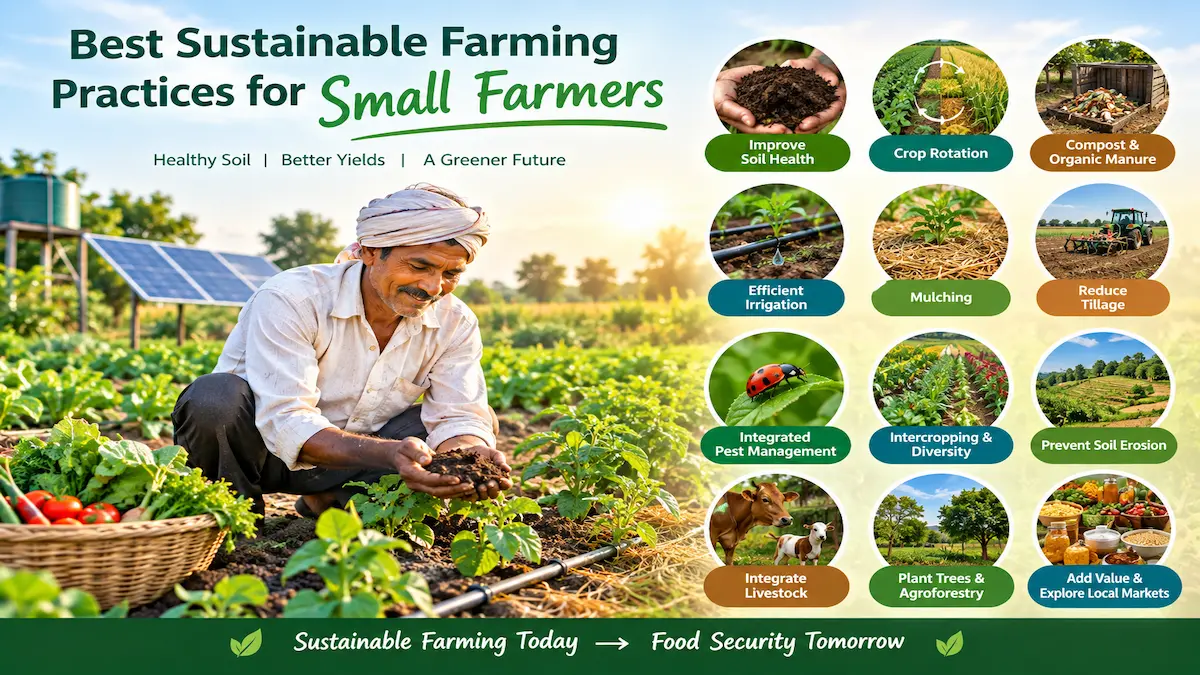
Agriculture is changing rapidly. Farmers today face many challenges, including rising input costs, declining soil fertility, water shortages, unpredictable weather, pests, and changing market conditions. These challenges can be especially difficult for small farmers who have limited land, capital, and access to expensive technology.
Sustainable farming offers a practical way forward. It focuses on producing food profitably while protecting soil, water, biodiversity, and the environment for future generations. Sustainable agriculture does not necessarily mean abandoning modern farming methods. Instead, it means using resources more efficiently and combining traditional knowledge with improved farming techniques.
For small farmers, even simple changes can make a significant difference. Here are some of the best sustainable farming practices that can improve productivity, reduce costs, and protect natural resources.
- Improve Soil Health
Healthy soil is the foundation of successful farming. Continuous cultivation, excessive tillage, chemical fertilizers, and removal of crop residues can gradually reduce soil quality.
Small farmers can improve soil health by regularly adding organic matter such as farmyard manure, compost, crop residues, and properly prepared vermicompost.
Organic matter improves soil structure, water-holding capacity, microbial activity, and nutrient availability. It can also reduce dependence on expensive external inputs over time.
Farmers should consider conducting soil tests periodically. Soil testing helps determine the nutrient requirements of a field and prevents unnecessary fertilizer application.
- Practice Crop Rotation
Growing the same crop repeatedly on the same land can increase pest and disease problems and gradually exhaust particular nutrients.
Crop rotation involves growing different crops in succession. For example, a farmer might grow wheat followed by a pulse crop and then another crop suited to the local climate.
Leguminous crops such as chickpea, lentil, pea, soybean, and certain beans can be particularly useful because they can contribute nitrogen to the soil through their association with nitrogen-fixing bacteria.
A well-planned crop rotation can improve soil fertility, interrupt pest cycles, reduce diseases, and make better use of available nutrients.
- Use Compost and Organic Manure
Small farms often have access to agricultural residues, animal manure, leaves, and other organic materials that can be converted into valuable soil amendments.
Composting these materials creates a nutrient-rich product that can be returned to the soil instead of being burned or discarded.
Farmers can prepare compost using crop residues, animal manure, dry leaves, vegetable waste, and other suitable biodegradable materials.
Vermicomposting is another useful option. Earthworms convert organic material into a nutrient-rich amendment that can improve soil fertility and structure.
Using locally available organic resources can reduce the amount of money spent on purchased inputs.
- Conserve Water Through Efficient Irrigation
Water is one of the most important resources in agriculture, and inefficient irrigation can waste large quantities of it.
Small farmers should select irrigation methods according to their crops, soil, climate, and available resources.
Drip irrigation can deliver water close to the root zone and is particularly useful for vegetables, fruits, and many high-value crops. Sprinkler irrigation can also improve water distribution for suitable crops.
Farmers should avoid unnecessary irrigation. Checking soil moisture before watering can prevent over-irrigation.
Mulching is another simple water-conservation technique. A layer of straw, crop residue, leaves, or other suitable material on the soil surface can reduce evaporation and help maintain soil moisture.
- Adopt Mulching
Mulching is one of the simplest sustainable practices available to small farmers.
Organic materials such as straw, dry leaves, grass, and crop residues can be placed around plants or across the soil surface.
Mulch helps reduce evaporation, suppress weeds, moderate soil temperature, and gradually add organic matter as it decomposes.
In vegetable gardens and orchards, mulching can be particularly beneficial during hot and dry periods.
Farmers should choose clean, suitable materials and manage mulch carefully to avoid creating conditions favorable to pests or diseases.
- Reduce Excessive Tillage
Traditional intensive tillage can disturb soil structure and accelerate the loss of organic matter. Repeated plowing can also increase fuel consumption and production costs.
Conservation agriculture encourages farmers to reduce unnecessary soil disturbance.
Depending on the crop and local conditions, farmers can explore reduced tillage, minimum tillage, or zero-tillage systems.
Less soil disturbance can help preserve soil structure, reduce erosion, conserve moisture, and protect beneficial organisms living in the soil.
However, tillage practices should be adapted to local conditions rather than following a single method everywhere.
- Use Integrated Pest Management
Pests can cause serious losses, but relying entirely on chemical pesticides can increase production costs and may harm beneficial insects and the surrounding environment when products are misused.
Integrated Pest Management, commonly called IPM, combines several methods to manage pests.
Farmers can monitor fields regularly and identify pests before populations become severe. Biological controls, resistant varieties, crop rotation, traps, mechanical removal, and cultural practices can all play a role.
Chemical pesticides may still be necessary in some situations, but they should be used carefully and according to approved recommendations.
The goal is not simply to eliminate every insect. Instead, the objective is to keep harmful pest populations below economically damaging levels while protecting beneficial organisms.
- Grow Diverse Crops
Crop diversity can make a small farm more resilient.
Instead of depending entirely on one crop, farmers can consider growing a combination of cereals, pulses, vegetables, fruits, oilseeds, or fodder crops according to their land and market opportunities.
Diversification can reduce the financial risk associated with crop failure or sudden price declines.
It can also improve biodiversity and provide different sources of food and income for the farming household.
For small farmers, diversification can be especially valuable because losing one crop does not necessarily mean losing the entire year’s income.
- Try Intercropping
Intercropping involves growing two or more crops together in the same field.
For example, a cereal crop can sometimes be combined with a suitable pulse crop. Farmers may also grow vegetables or other compatible crops between rows of larger plants.
Properly designed intercropping systems can make better use of sunlight, water, nutrients, and available land.
Some combinations can also reduce pest pressure or provide additional products from the same field.
Farmers should select crops that are compatible in terms of maturity period, plant height, nutrient requirements, and water needs.
- Protect the Farm From Soil Erosion
Soil erosion can remove valuable topsoil and reduce long-term farm productivity.
Farmers can reduce erosion by maintaining ground cover, using crop residues as mulch, planting cover crops, establishing grass strips, and avoiding unnecessary soil disturbance.
On sloping land, contour farming, terraces, and other soil-conservation structures may be appropriate.
Planting trees or shrubs around suitable field boundaries can also help stabilize soil and provide additional benefits such as shade, fodder, fruits, fuelwood, or habitat for wildlife.
- Recycle Farm Waste
Farm waste should not automatically be treated as useless material.
Crop residues can be composted, incorporated appropriately into soil, used as mulch, or utilized as animal feed where suitable.
Animal manure can be converted into compost or used in biogas systems.
Agricultural waste recycling reduces the need to purchase certain inputs and minimizes waste burning.
Avoiding the open burning of crop residues can also help reduce air pollution and protect valuable organic material that could otherwise return nutrients to the soil.
- Integrate Livestock With Crop Production
Small farmers who have suitable resources can benefit from integrating crops and livestock.
Crop residues can provide feed for animals, while properly managed animal manure can return nutrients to agricultural fields.
This creates a more circular farming system in which outputs from one part of the farm become inputs for another.
Livestock can also provide farmers with an additional source of income, milk, meat, eggs, manure, or other products depending on the type of enterprise.
However, farmers should choose livestock numbers according to available feed, water, land, labor, and veterinary support.
- Plant Trees and Explore Agroforestry
Agroforestry combines trees with crops, livestock, or both.
Suitable trees planted around fields or in planned arrangements can provide fruits, fodder, timber, fuelwood, shade, and additional income.
Trees can also contribute to biodiversity, improve the farm landscape, and help protect soil from wind and water erosion.
The correct species should be selected carefully. Farmers should consider local climate, soil, water availability, root behavior, market demand, and compatibility with crops.
- Select Climate-Suitable Crop Varieties
Weather patterns are becoming increasingly challenging for farmers in many regions. Droughts, heavy rainfall, heat waves, and changing pest patterns can affect agricultural production.
Farmers should consider crop varieties suited to their local conditions. Depending on the region, this may include varieties with better drought tolerance, disease resistance, shorter maturity periods, or improved heat tolerance.
Using quality seed from reliable sources is also important.
Good seed cannot eliminate all production risks, but it can provide a stronger foundation for a healthy crop.
- Use Fertilizers Wisely
Sustainable agriculture does not necessarily mean completely eliminating chemical fertilizers.
The important principle is to use nutrients according to actual crop requirements.
Applying more fertilizer than the crop can use wastes money and may contribute to nutrient losses into the environment.
A combination of soil testing, organic manure, compost, biological inputs where appropriate, and carefully calculated fertilizer application can improve nutrient-use efficiency.
Farmers should follow local agricultural recommendations rather than applying fertilizer based solely on habit.
- Keep Farm Records
Record keeping is a simple practice that is often overlooked.
Farmers should record important information such as seed costs, fertilizer use, pesticide expenses, irrigation costs, labor, yields, and selling prices.
These records help farmers understand which crops and practices are actually profitable.
For example, a crop producing a high yield may not necessarily generate the highest profit if its input costs are also very high.
Even a simple notebook can become a valuable farm-management tool.
- Use Technology Carefully
Technology can support sustainable farming when it solves a genuine problem.
Farmers can use mobile phones to access weather forecasts, agricultural advisories, market prices, pest-identification information, and government agricultural services where available.
Soil-moisture sensors, weather stations, precision irrigation, improved farm machinery, and digital record keeping may also help farmers who have access to them.
However, technology should not be adopted simply because it is new. Small farmers should first consider whether the technology will reduce costs, save resources, increase productivity, or improve income.
- Focus on Local Markets and Value Addition
Sustainability is not only about the environment. A farm must also be economically sustainable.
Small farmers can explore opportunities to sell products directly to consumers, local retailers, restaurants, processors, farmer groups, or cooperatives where practical.
Value addition can also increase the earning potential of agricultural products. Depending on local regulations and facilities, farmers may consider products such as cleaned and packaged grains, processed foods, dried fruits, pickles, or other farm-based products.
Better market planning can reduce dependence on a single buyer.
Conclusion
Sustainable farming is not one particular technique. It is a way of managing a farm so that soil, water, biodiversity, money, and labor are used responsibly.
For small farmers, sustainability does not require expensive machinery or complicated technology. Practices such as composting, crop rotation, mulching, efficient irrigation, integrated pest management, crop diversification, reduced tillage, soil conservation, and farm-waste recycling can often be introduced gradually.
The best approach is to start with practices that fit the farm’s local conditions and financial capacity. Farmers can test a new method on a small portion of their land, compare the results, and expand it when the benefits are clear.
A sustainable farm should aim for three things at the same time: healthy land, profitable production, and responsible use of natural resources.
By adopting practical sustainable farming practices today, small farmers can improve the resilience of their farms and help ensure that productive agricultural land remains available for future generations.