


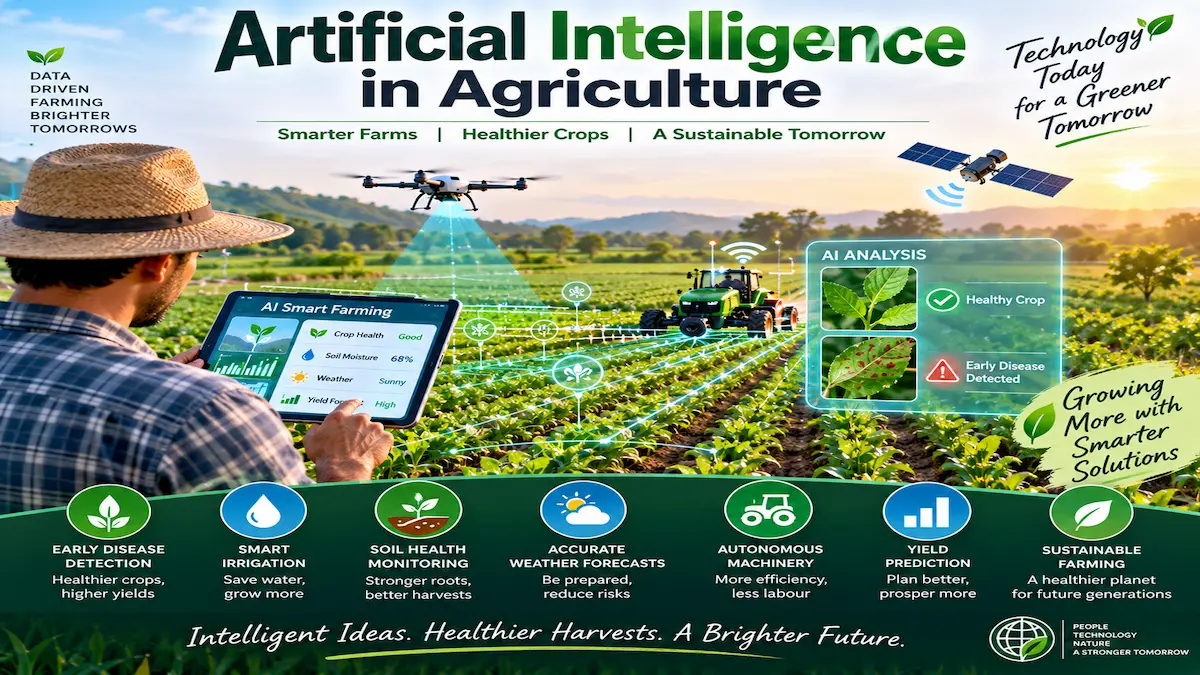
Agriculture is entering a new technological era. For centuries, farming has depended on human experience, traditional knowledge, weather patterns, and natural resources. Today, however, farmers are increasingly using digital technologies to make faster and more informed decisions. Among these technologies, Artificial Intelligence (AI) is emerging as one of the most powerful tools capable of transforming modern agriculture.
Artificial Intelligence enables machines and computer systems to learn from data, identify patterns, make predictions, and support decision-making. When applied to agriculture, AI can help farmers understand their fields more accurately, detect crop problems at an early stage, manage water and fertilizers efficiently, predict weather-related risks, and improve productivity.
The importance of AI in agriculture goes beyond simply introducing machines into farms. Its real value lies in helping farmers make smarter decisions using information. As agriculture faces challenges such as climate change, water scarcity, soil degradation, labour shortages, changing weather conditions, and rising food demand, AI could become an important part of building a more efficient and sustainable food system.
What Is Artificial Intelligence in Agriculture?
Artificial Intelligence in agriculture refers to the use of AI-powered software, machines, sensors, cameras, drones, robots, and data-analysis systems to perform or assist with agricultural tasks.
A traditional farmer may look at a crop and notice that some plants appear unhealthy. An AI-based system can examine thousands of plants using cameras or images and identify subtle differences that may not be easily visible to the human eye. Similarly, instead of relying only on a fixed irrigation schedule, an intelligent system can analyse soil moisture, temperature, weather information, and crop requirements to support better watering decisions.
AI works particularly well when combined with other technologies such as the Internet of Things (IoT), satellite imagery, drones, GPS, robotics, cloud computing, and precision agriculture. Together, these technologies create a more connected and data-driven farming environment.
AI for Early Detection of Crop Diseases
Crop diseases can spread rapidly and cause significant losses if they are not identified in time. Traditionally, farmers have relied on visual inspection or agricultural experts to identify diseases. However, large farms can be difficult to monitor manually.
AI-powered image recognition can assist by analysing photographs of leaves, fruits, stems, and other plant parts. Machine-learning models can be trained using large collections of healthy and diseased plant images. When a new image is analysed, the system can identify patterns that may indicate a disease or nutritional problem.
Early detection allows farmers to investigate the affected area and take appropriate action more quickly. This may reduce unnecessary treatment of healthy crops and support more targeted crop protection.
AI should not replace agricultural experts, particularly when a diagnosis is uncertain. Instead, it can act as an early-warning and decision-support tool.
Precision Farming Becomes More Intelligent
Precision agriculture focuses on managing different parts of a farm according to their specific requirements rather than treating an entire field in exactly the same way.
Not every section of a field has identical soil fertility, moisture, crop growth, or nutrient requirements. AI can analyse data collected from sensors, satellites, drones, machinery, and field observations to identify these differences.
For example, an AI system may identify one part of a field that is receiving insufficient moisture while another area has adequate water. It can also analyse historical crop performance and soil information to support more precise decisions about irrigation, fertilization, and crop protection.
This approach can help farmers use inputs more efficiently while maintaining productive crops.
Smarter Irrigation and Water Management
Water is one of agriculture’s most valuable resources. In many parts of the world, farmers are facing increasing pressure on groundwater and other sources of irrigation water.
AI can contribute to smarter water management by analysing several factors simultaneously. These may include soil moisture, crop growth stage, temperature, humidity, rainfall forecasts, and historical irrigation data.
An intelligent irrigation system can use this information to recommend or automatically adjust irrigation according to field conditions. When rainfall is expected, irrigation may be reduced or postponed. When soil moisture becomes low, the system can alert the farmer or activate an automated irrigation system where appropriate.
The objective is not simply to use less water but to use water more intelligently, reducing avoidable losses while supporting crop health.
AI and Weather Prediction
Weather is one of the biggest uncertainties in farming. A sudden heat wave, heavy rainfall, frost, drought, or storm can affect crops within a short period.
AI can analyse large amounts of historical and real-time weather data to identify patterns and improve agricultural forecasting. When combined with local weather stations and satellite information, AI-powered systems can provide farmers with useful predictions and alerts.
For example, weather intelligence can help farmers decide when to irrigate, sow seeds, apply certain agricultural inputs, or harvest crops. Timely information can be particularly valuable when weather conditions are changing rapidly.
Although AI-based forecasts cannot eliminate uncertainty, they can provide farmers with additional information for making better-informed decisions.
Intelligent Pest Management
Insects and pests can cause serious damage to agricultural crops. Conventional pest management may sometimes involve treating large areas even when only a limited portion of a field is affected.
AI can help make pest management more targeted. Cameras, drones, and sensors can collect images or field data, while AI models analyse these inputs to identify signs of pest activity.
Instead of assuming that the entire field has the same problem, farmers can investigate specific areas where a potential infestation has been detected. This can support more efficient crop protection and reduce unnecessary use of agricultural inputs.
AI-based pest monitoring can also become more valuable when historical information is included. If certain pests regularly appear under particular environmental conditions, predictive systems may help farmers prepare earlier.
AI-Powered Agricultural Robots
Agricultural robots are another exciting application of AI. Robots can be designed to assist with repetitive agricultural tasks such as monitoring crops, removing weeds, harvesting certain crops, and transporting materials.
AI gives robots the ability to interpret their surroundings and respond to changing conditions. Cameras and sensors can help a robot distinguish between crops and weeds, navigate fields, and identify objects.
In the future, greater use of intelligent machinery could help address labour shortages in certain agricultural operations. However, the adoption of agricultural robots will depend on cost, farm size, crop type, terrain, maintenance requirements, and availability of technical support.
Predicting Crop Yield
Knowing the likely yield of a crop can be valuable for farmers, food processors, traders, and policymakers.
AI can analyse information such as historical yields, weather conditions, soil characteristics, satellite images, crop health indicators, and farming practices to estimate potential production.
Yield prediction can help farmers plan harvesting, storage, transportation, and marketing. At a broader level, accurate agricultural forecasting can contribute to better food-supply planning.
However, predictions are estimates rather than guarantees. Unexpected weather events, disease outbreaks, market conditions, and other factors can still influence final production.
AI for Soil Health
Healthy soil is the foundation of productive agriculture. AI can assist farmers in understanding changes in soil conditions by analysing information from soil sensors, laboratory tests, satellite imagery, and historical field records.
Machine-learning systems can identify relationships between soil characteristics, crop performance, weather, and farming practices. This information may support better decisions about crop rotation, nutrient management, irrigation, and soil conservation.
In the long term, AI could contribute to farming approaches that focus not only on producing crops but also on maintaining the health and productivity of the land.
Supporting Farmers with Digital Advisory Systems
One of the most promising applications of AI is the development of digital agricultural advisory tools. Farmers can potentially use smartphones or other devices to access information about crops, weather, irrigation, soil, pests, and farm management.
AI-based systems can analyse a farmer’s specific information and provide recommendations suited to particular circumstances. This could be especially useful where access to agricultural experts is limited.
However, agricultural advice must be carefully designed and validated. AI systems can make mistakes if their training data is incomplete, inaccurate, or unsuitable for a particular region. Local agricultural knowledge and expert guidance therefore remain extremely important.
Benefits of Artificial Intelligence in Agriculture
The adoption of AI can provide several potential benefits:
Improved decision-making: Farmers can use data rather than relying solely on assumptions or fixed schedules.
Better resource efficiency: Water, fertilizers, energy, and other inputs can potentially be used more precisely.
Early problem detection: Crop diseases, pests, and environmental stress may be identified earlier.
Higher productivity: Better management can support improved crop performance.
Reduced labour pressure: Automation can assist with repetitive monitoring and farm tasks.
Climate resilience: Weather intelligence and predictive tools can help farmers prepare for changing conditions.
Reduced wastage: Better forecasting and monitoring can improve the use of agricultural resources.
Improved farm planning: Data from several seasons can help farmers identify patterns and make future decisions.
Challenges of Using AI in Agriculture
Despite its enormous potential, AI is not a magic solution for every agricultural problem.
The first challenge is cost. Advanced sensors, drones, robots, software, and connectivity can be expensive, particularly for small farmers.
Another challenge is digital literacy. Farmers need training to understand how these technologies work and how to interpret their results.
The quality of AI depends heavily on the quality of data. If data is inaccurate, incomplete, or not representative of local farming conditions, an AI system may produce unreliable recommendations.
Connectivity is another concern in rural areas. Many AI applications depend on internet access, cloud services, or reliable mobile networks. Maintenance and technical support are equally important.
There are also questions about data ownership and privacy. Farmers should understand who collects farm data, how it is stored, and how it may be used.
Most importantly, AI should be viewed as a tool that supports farmers rather than a replacement for farmers. Agricultural decisions often involve local knowledge, experience, economic considerations, and unpredictable natural conditions that cannot be fully captured by a computer model.
The Future of AI in Agriculture
The future of agriculture is likely to involve closer cooperation between farmers and intelligent technologies. Farms may increasingly use interconnected networks of sensors, autonomous machinery, drones, satellites, weather stations, and AI systems.
AI could help create farms where irrigation, crop monitoring, fertilization, pest management, and machinery operations are coordinated through a common digital platform. Farmers may be able to monitor large areas of farmland from a smartphone while receiving alerts about conditions that require attention.
However, the most successful agricultural AI solutions will not necessarily be the most complicated ones. Technologies that are affordable, easy to operate, locally relevant, and genuinely useful to farmers are more likely to have lasting impact.
Governments, agricultural universities, technology companies, researchers, cooperatives, and farmer organisations all have a role to play in making AI accessible. Training programmes, affordable technology, reliable rural connectivity, and responsible data policies will be essential for inclusive adoption.
Conclusion
Artificial Intelligence is opening a new chapter in the history of agriculture. From identifying crop diseases and predicting yields to managing water, monitoring pests, analysing soil, and supporting farm decisions, AI has the potential to make farming more precise and responsive.
Its greatest contribution may be the ability to turn enormous amounts of agricultural data into useful knowledge for everyday decisions. Instead of treating every part of a farm in the same way, farmers can increasingly understand what individual crops and fields actually need.
The future of farming will not be about choosing between human knowledge and technology. It will be about bringing the two together. Farmers possess generations of practical experience, while AI can process vast quantities of information at remarkable speed. When these strengths are combined responsibly, agriculture can become more productive, resource-efficient, sustainable, and resilient.
Artificial Intelligence will not eliminate the uncertainties of farming, because agriculture will always depend on nature. But it can give farmers better tools to understand those uncertainties and respond to them.
The farm of the future will not simply be automated—it will be intelligent, connected, and guided by better information.