


How Important Is Agriculture to India, the United States and Europe?
In 1950, agriculture was at the heart of economic life across much of the world. For millions of families, farming was not simply an occupation—it was their livelihood, identity, food source and connection to the land. Villages dominated the landscape, farm work employed a huge share of the population, and national economies depended heavily on what farmers produced.
But fast-forward to 2026, and the picture looks dramatically different.
Agriculture is still essential. Without farmers, there is no food, no raw material for many industries and no functioning food system. Yet agriculture now employs a much smaller proportion of workers in most developed economies. Millions of people have moved from farms into factories, offices, construction, technology, transport, healthcare, education and other services.
So, what happened?
The answer is not simply that people stopped liking farming. Economic development transformed agriculture itself.
India in 1950: Agriculture at the Centre of the Economy
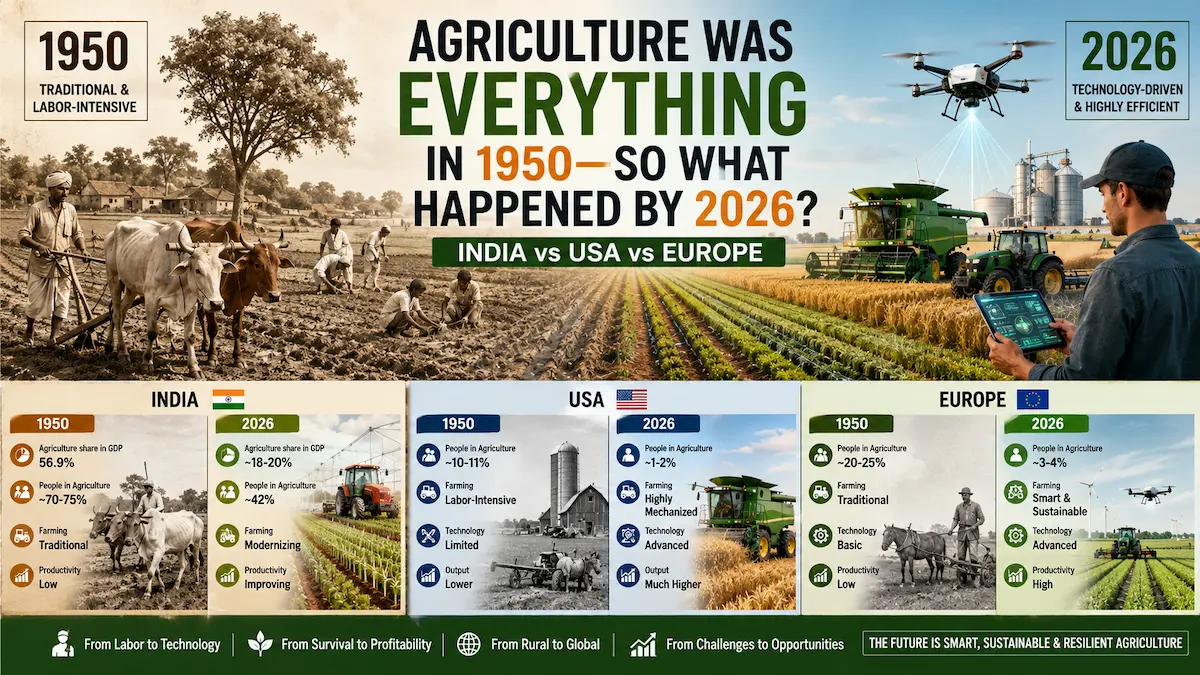
At the time of India’s independence, agriculture dominated the economy. In 1950, agriculture accounted for about 56.9% of India’s GDP, according to historical data compiled by the World Bank. Manufacturing accounted for around 10.6%, while services accounted for about 31.8%.
The reason was straightforward: India was overwhelmingly rural, industrialisation was still at an early stage, and millions of families depended directly on agriculture.
Farming was also far more labour-intensive than it is today. Tractors, modern irrigation, improved seeds, chemical fertilisers, sophisticated machinery, cold chains and digital agricultural technologies were either unavailable or used on a very limited scale.
For a young person in 1950, farming was often one of the few realistic ways to earn a living.
But that began to change.
India by 2026: Agriculture Is Still Huge—but Its Economic Share Has Fallen
India has experienced enormous structural transformation since 1950. Manufacturing and, particularly, services have expanded rapidly.
The Economic Survey 2025–26 says agriculture and allied activities now contribute nearly one-fifth of India’s national income at current prices, while accounting for 46.1% of the country’s workforce.
This creates an important economic puzzle.
Nearly half of India’s workforce remains connected to agriculture, but the sector contributes a much smaller share of national income than it did in 1950.
This means that agricultural productivity and incomes have become a major issue.
India’s agriculture also faces structural challenges such as fragmented landholdings, limited irrigation in some regions, inadequate investment, relatively low mechanisation and stagnating yields for some crops.
At the same time, agriculture is changing. Horticulture, dairy, fisheries, poultry, food processing, agricultural technology and direct-to-consumer businesses are creating new opportunities.
The future may therefore not be about abandoning agriculture—but about making agriculture more productive and profitable.
What Happened in the United States?
The American story is very different.
In 1950, the United States still had millions of people working on farms. USDA historical data show that about 7.6 million self-employed farmers and family farmworkers and approximately 2.33 million hired farmworkers were involved in farming in 1950.
Then came an extraordinary wave of mechanisation.
Tractors replaced much of the physical labour previously performed by people and animals. Combines harvested enormous areas of grain. Better seeds, fertilisers, pesticides, irrigation, machinery, logistics and agricultural research dramatically increased productivity.
As a result, the United States could produce more food with far fewer workers.
Between 1950 and 2000, the number of self-employed and family farmworkers fell from 7.60 million to 2.06 million—a 73% decline. Hired farm employment also fell substantially.
This did not mean American agriculture disappeared.
Quite the opposite.
American farms became highly productive, specialised and capital-intensive.
Today, direct on-farm employment represents only a small fraction of total U.S. employment. In 2022, direct on-farm employment was about 1.2% of U.S. employment, while agriculture and food-related industries together supported 10.4% of total employment.
This is one of the biggest lessons of the American experience:
A country can have fewer farmers without having less agriculture.
Europe: From Millions of Farmers to a Highly Mechanised Food System
Europe followed a similar long-term transformation.
After World War II, European countries experienced rapid industrialisation and urbanisation. Rural populations moved toward cities, while agriculture became increasingly mechanised and productive.
Today, agriculture represents only a small share of employment across the European Union.
Eurostat’s latest figures show that agriculture, forestry and fishing accounted for 3.8% of EU employment in 2025, down from 8.6% in 2000. During the same period, services increased from 64.7% to 74.4% of employment.
The European farming sector has also experienced consolidation. The EU had around 8.8 million agricultural holdings in 2023, with family farms still making up the overwhelming majority.
However, European agriculture is not simply disappearing. It is becoming more technology-driven, specialised and productive.
In 2025, EU agricultural labour productivity increased by an estimated 9.2%, while the volume of agricultural labour declined by about 1%.
Again, the pattern is clear: fewer workers can produce more output.
India vs USA vs Europe: Three Different Stages of the Same Transformation
The three regions tell an interesting story.
India still has a very large agricultural workforce. The country’s challenge is to increase productivity and farmer income while creating productive jobs outside agriculture.
The United States completed much of this transformation decades ago. Mechanisation and technology dramatically reduced the number of people required to produce food.
Europe followed a similar path, with agriculture now employing only a small share of the workforce.
The World Bank’s latest ILO-modelled data put agricultural employment at approximately 42% of total employment in India in 2025, compared with around 2% in the United States and 3% in the European Union.
These numbers reveal the enormous difference in economic structure.
But they also reveal something else.
Why Are Young People Leaving Farming?
The reasons are not difficult to understand.
Young people compare farming with other careers.
They see jobs offering:
- Regular monthly salaries
- Better access to education
- Greater career progression
- Less dependence on weather
- More predictable working hours
- Opportunities to live in cities
- Access to technology and modern workplaces
- Potentially higher and more stable incomes
Traditional farming can involve long hours, uncertain weather, fluctuating crop prices, rising input costs and fragmented land.
For many young people, therefore, leaving farming is not a rejection of agriculture.
It is an economic decision.
But Is Agriculture Really Losing Its Importance?
Not at all.
Agriculture may employ fewer people, but its importance to society remains enormous.
Food security, climate change, water management, soil health, rural development and global food prices all depend on agriculture.
The real question for India is not:
“How do we keep every young person on the farm?”
It should be:
“How do we make farming attractive enough that young people choose it because it is profitable, modern and rewarding?”
That means moving beyond traditional crop production toward high-value agriculture, precision farming, protected cultivation, horticulture, livestock, fisheries, food processing, agricultural exports, farm technology and better market connections.
The Future: Fewer Farmers, But Smarter Farming?
The story from 1950 to 2026 is ultimately a story of economic transformation.
In 1950, agriculture needed enormous amounts of human labour.
By 2026, technology allows one farmer to manage much more land and produce much more food than previous generations could.
The United States and Europe demonstrate what happens when mechanisation, investment, technology and non-farm employment develop rapidly.
India is somewhere in the middle of this transformation.
Its agricultural workforce is still enormous, but the country’s economy is increasingly driven by manufacturing and services.
The challenge is to ensure that this transition does not leave farmers behind.
Agriculture was everything in 1950. In 2026, agriculture may employ fewer people—but it remains the foundation of human survival.
The future of farming will probably not belong to the farmer who simply works harder.
It will belong to the farmer who combines land, knowledge, technology, markets, finance and innovation.
And perhaps that is the real transformation agriculture has undergone in the last 75 years:
from a labour-intensive way of life to a technology-driven business—and the transformation is still continuing.