Agriculture has always depended on water, but the way water is used in farming is changing rapidly. With growing populations, unpredictable weather, declining groundwater levels, and increasing pressure on natural resources, farmers can no longer rely entirely on traditional irrigation methods. Smart irrigation has emerged as an important solution that combines agriculture with modern technology to deliver the right amount of water to crops at the right time.
Smart irrigation is not simply about supplying water automatically. It is an intelligent approach that uses sensors, weather information, automation, data analysis, and efficient irrigation systems to reduce unnecessary water use while maintaining healthy crop growth. It is becoming an important part of modern farming and has the potential to make agriculture more productive, sustainable, and climate-resilient.
What Is Smart Irrigation?
Smart irrigation refers to the use of technology to monitor crop and soil conditions and manage irrigation according to the actual water requirements of plants. In conventional farming, irrigation may be carried out according to a fixed schedule. However, crops do not always need the same amount of water. Their requirements change depending on soil type, crop stage, temperature, rainfall, humidity, and weather conditions.
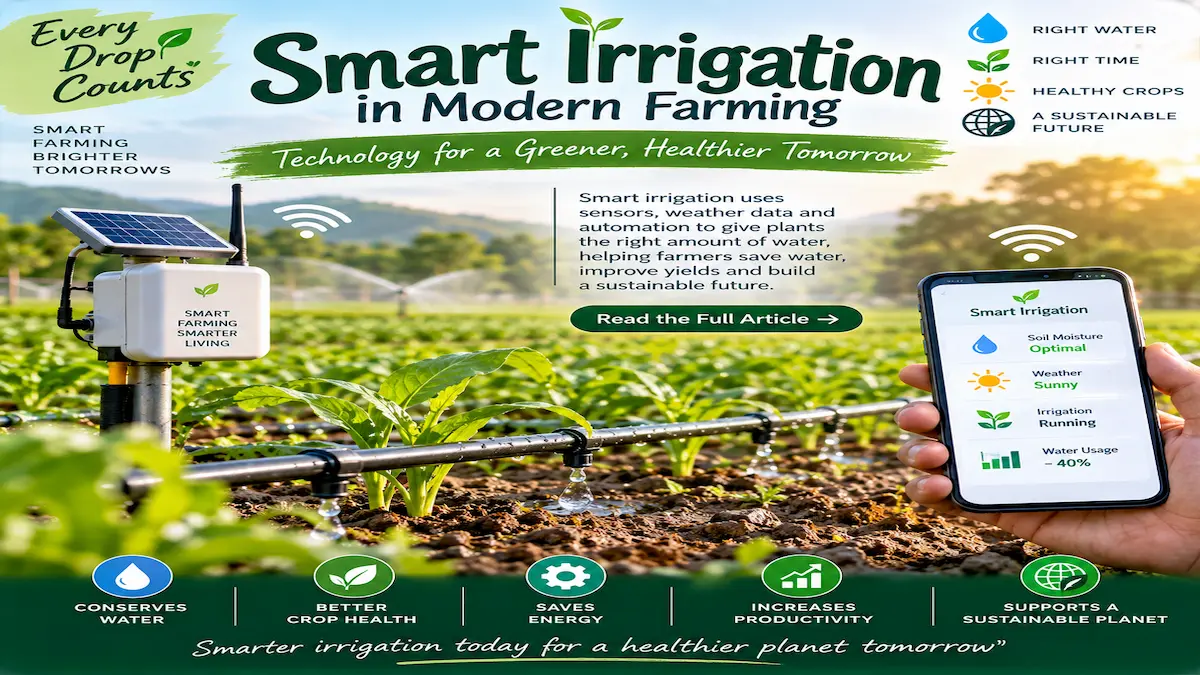
A smart irrigation system collects information from the farm and uses it to determine when irrigation is needed and how much water should be supplied. For example, soil-moisture sensors can detect whether the soil is sufficiently wet. If the moisture level falls below a selected threshold, the system can activate irrigation. When enough moisture is available, irrigation can be reduced or stopped.
This makes irrigation more responsive to the actual needs of crops rather than relying on guesswork.
Major Technologies Used in Smart Irrigation
One of the most important technologies in smart irrigation is the soil-moisture sensor. These sensors are placed in the soil to measure its moisture content. The information can be sent to a controller, smartphone, or farm management platform, allowing farmers to make informed irrigation decisions.
Weather-based technology is another important component. Modern systems can use temperature, rainfall forecasts, humidity, wind speed, and other weather information to adjust irrigation schedules. If significant rainfall is expected, irrigation can be postponed, preventing unnecessary water consumption.
Drip irrigation is particularly suitable for smart farming. Instead of flooding an entire field, drip systems deliver water slowly and directly near the roots of plants. When combined with sensors and automation, they can provide precise irrigation with considerably less wastage.
Internet of Things (IoT) devices can connect sensors, pumps, valves, and monitoring systems. Farmers may be able to observe field conditions remotely through a mobile phone or computer. This is especially useful for farms spread over large areas.
Some advanced agricultural systems also use satellite images, drones, artificial intelligence, and data analytics. These technologies can help identify areas of a field that are experiencing water stress and support more precise irrigation decisions.
Benefits for Farmers
The most obvious advantage of smart irrigation is water conservation. Traditional irrigation can result in water loss through evaporation, runoff, and excessive application. Smart systems can reduce unnecessary irrigation by supplying water according to crop and soil conditions.
Another major benefit is better crop management. Both under-irrigation and over-irrigation can negatively affect crops. Insufficient water may cause stress and reduce growth, while excessive water can lead to root problems, nutrient loss, and other difficulties. Smart irrigation helps maintain more appropriate soil-moisture conditions.
Smart irrigation can also reduce labour requirements. Once an automated system is properly installed and configured, some irrigation activities can be controlled automatically. Farmers do not always need to visit the field simply to switch pumps or valves on and off.
There can also be energy savings. When pumps operate only when necessary, electricity or fuel consumption may decrease. This can be particularly valuable in areas where irrigation pumps account for a significant portion of farm energy use.
Smart Irrigation and Climate Change
Climate change is making farming more challenging. Farmers in many regions are experiencing irregular rainfall, longer dry periods, heat waves, and unpredictable weather patterns. Under such conditions, efficient water management becomes increasingly important.
Smart irrigation can help farmers respond to these uncertainties. Instead of following a fixed irrigation calendar, farmers can use current field and weather information to adjust watering decisions. This flexibility can improve the farm’s ability to cope with changing environmental conditions.
Efficient irrigation also contributes to sustainable agriculture. Saving water helps protect groundwater reserves, rivers, lakes, and other water resources. When less water is wasted, farmers can potentially produce more with the same or even smaller quantities of water.
Challenges in Adopting Smart Irrigation
Despite its advantages, smart irrigation is not without challenges. Initial installation costs can be a major concern, especially for small and marginal farmers. Sensors, automated controllers, pumps, communication equipment, and drip systems may require significant investment.
Farmers may also need technical knowledge to install, operate, maintain, and interpret smart irrigation equipment. Poorly calibrated sensors or damaged devices can provide incorrect information and affect irrigation decisions.
Connectivity can be another challenge in rural areas. Some advanced systems depend on reliable internet or mobile networks. Power availability can also influence the operation of automated irrigation equipment.
Therefore, technology alone is not enough. Farmers need access to training, technical support, affordable equipment, financing, and reliable agricultural advisory services.
Making Smart Irrigation Accessible
For smart irrigation to become widely useful, solutions should be designed according to local farming conditions. A large commercial farm may use sophisticated IoT platforms and satellite-based monitoring, while a small farmer may benefit more from a simple soil-moisture sensor connected to an automated drip irrigation system.
Governments, agricultural universities, technology companies, cooperatives, and farmer organisations can play an important role in promoting affordable smart irrigation. Demonstration farms and training programmes can help farmers understand the practical benefits of these technologies.
The future may also bring more AI-powered irrigation systems capable of analysing large amounts of agricultural data and making increasingly precise recommendations. However, farmers should remain central to decision-making, with technology serving as a tool rather than replacing agricultural knowledge and experience.
The Future of Water-Smart Agriculture
Smart irrigation represents a significant shift from “irrigate by routine” to “irrigate by information.” Instead of asking whether it is time to water the field, farmers can increasingly ask whether the crop actually needs water, how much it needs, and where it is required.
The combination of sensors, drip irrigation, weather forecasting, automation, IoT, satellite monitoring, and data analytics can make irrigation more precise and efficient. As these technologies become more affordable and easier to use, they could become increasingly common on farms of different sizes.
Ultimately, smart irrigation is not just a technological innovation. It is part of a broader movement towards responsible and sustainable farming. Water is one of agriculture’s most valuable resources, and using it wisely is essential for both present and future generations.
Conclusion
Modern agriculture must produce more food while facing limited water resources and an uncertain climate. Smart irrigation offers a practical pathway towards achieving this balance. By understanding soil conditions, monitoring weather, delivering water precisely, and automating irrigation where appropriate, farmers can reduce wastage and improve water-use efficiency.
The goal of smart irrigation is not simply to use less water—it is to use every drop more intelligently. When technology and traditional farming knowledge work together, irrigation can become more efficient, sustainable, and responsive. In the years ahead, smart irrigation is likely to play an increasingly important role in building a resilient agricultural system capable of feeding a growing population while protecting one of our planet’s most precious resources.