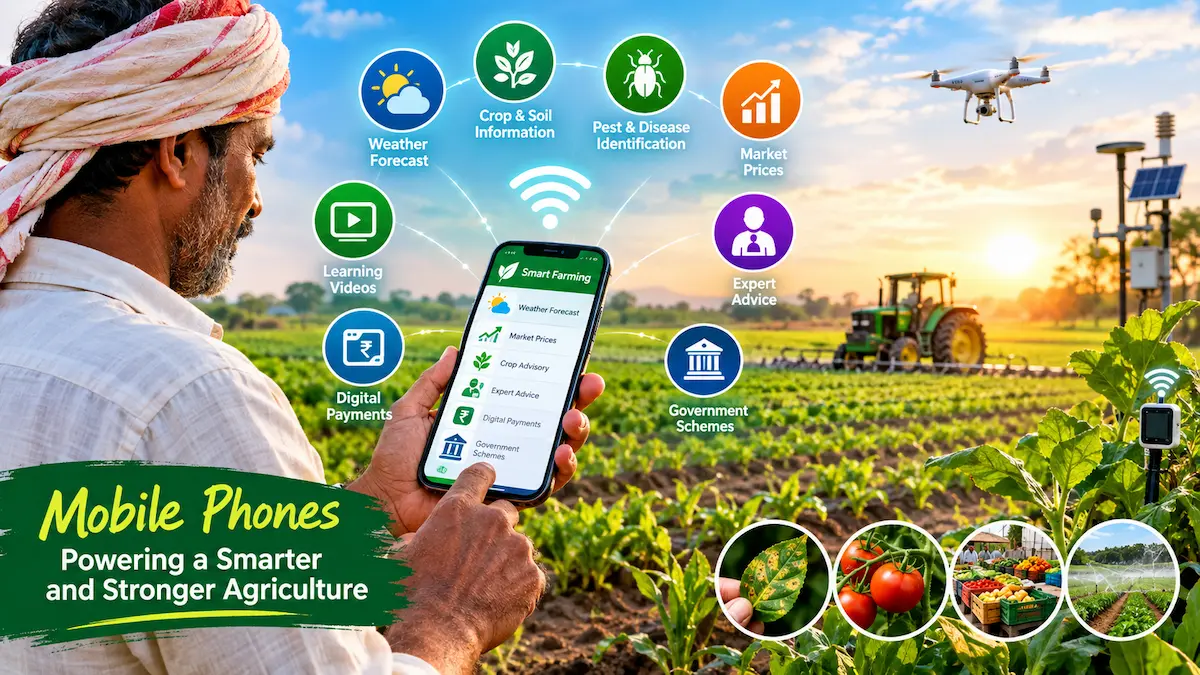
Agriculture has always depended on land, water, weather, seeds, and the hard work of farmers. But in the modern era, another powerful tool has entered the field—the mobile phone. What was once mainly used for calling and messaging has now become a valuable agricultural tool capable of providing weather forecasts, market prices, farming advice, digital payments, crop information, and access to agricultural experts.
The rapid spread of affordable smartphones and mobile internet has changed the way farmers obtain information and make decisions. From a small farmer growing vegetables to a large commercial farm managing hundreds of acres, mobile technology can help improve productivity, reduce costs, and connect farmers directly with markets.
Mobile Phones as a Farming Information Tool
One of the biggest advantages of mobile phones in agriculture is easy access to information.
In the past, farmers often depended on personal experience, local traders, agricultural officers, newspapers, or other farmers for information. Today, a farmer can search for information on a smartphone within seconds.
Farmers can use mobile phones to learn about:
Crop cultivation techniques
Seed varieties
Fertilizer requirements
Pest and disease management
Irrigation methods
Soil health
Government agricultural schemes
Organic farming
Modern machinery
Post-harvest management
This quick access to knowledge can be particularly valuable when farmers face an unexpected problem in the field.
Weather Forecasts Help Farmers Make Better Decisions
Weather plays a major role in agriculture. Unexpected rain, drought, heatwaves, storms, or strong winds can damage crops and affect farm operations.
Mobile weather applications allow farmers to check forecasts before making important decisions. For example, a farmer can decide whether to irrigate a field, apply fertilizer, spray pesticides, harvest a crop, or postpone farm work based on expected weather conditions.
Weather information can therefore help reduce unnecessary expenditure and protect crops from avoidable losses.
Identifying Crop Diseases Through Smartphones
Modern smartphones are equipped with good-quality cameras. This simple feature has created new possibilities for farmers.
A farmer can photograph a diseased leaf or damaged fruit and share the image with an agricultural expert, extension worker, farmer group, or digital advisory service. In some cases, artificial intelligence-based applications can also help identify possible crop diseases and pests from photographs.
However, digital identification should be treated as a helpful starting point rather than a replacement for professional agricultural advice. Correct diagnosis is important before applying pesticides or other treatments.
Mobile Phones and Market Prices
Selling agricultural produce at the right price is one of the biggest challenges faced by farmers.
Mobile phones can provide farmers with information about prices in different markets. By comparing prices before transporting their produce, farmers may be able to make better selling decisions.
For example, a vegetable grower can check prices in nearby markets before sending a truckload of tomatoes, onions, potatoes, or other produce. Such information can improve the farmer’s bargaining position and reduce dependence on a single buyer.
Mobile connectivity can also help farmers communicate directly with wholesalers, retailers, food processors, and consumers.
Digital Payments Make Agricultural Transactions Easier
The growth of digital payments has transformed financial transactions in rural areas.
Farmers can use mobile phones to make or receive payments for seeds, fertilizers, machinery services, transportation, agricultural products, and other goods. Digital payments can reduce the need to carry cash and provide a record of transactions.
Mobile banking can also make it easier for farmers to receive government benefits, insurance payments, subsidies, or other financial assistance where such digital systems are available.
Access to Agricultural Experts
Farmers do not always have an agricultural expert nearby. Mobile phones can help bridge this gap.
Through telephone calls, messaging applications, video calls, online communities, and agricultural helplines, farmers can communicate with experts and other farmers.
A farmer facing a problem with irrigation, insects, plant nutrition, or crop management can seek advice without necessarily travelling long distances to an agricultural office.
This is especially useful for farmers in remote areas.
Learning Through Agricultural Videos
Video has become one of the most effective ways of learning farming techniques.
Farmers can watch videos demonstrating:
Seed treatment
Nursery preparation
Drip irrigation
Pruning
Compost production
Vermicomposting
Dairy farming
Poultry management
Farm machinery operation
Organic farming
Post-harvest processing
Instead of reading complicated instructions, farmers can watch a process being demonstrated step by step.
This also creates opportunities for younger people to learn about modern agriculture and develop interest in farming as a technology-driven profession.
Mobile Phones Support Precision Agriculture
Mobile technology is also becoming an important part of precision agriculture.
Modern farming increasingly uses GPS, sensors, satellite data, drones, weather stations, and farm-management applications. Smartphones can act as a central interface through which farmers receive and monitor some of this information.
For example, farmers may use mobile applications to monitor irrigation schedules, field conditions, machinery operations, weather information, or crop activities.
When combined with sensors and other technologies, mobile phones can help farmers move from traditional “one-size-fits-all” farming toward more precise management of individual fields.
Government Agricultural Services
Governments and agricultural institutions are increasingly using mobile technology to reach farmers.
Through mobile applications, SMS messages, websites, and digital platforms, farmers can receive information about agricultural schemes, crop advisories, weather alerts, training programmes, insurance, subsidies, and other services.
The mobile phone therefore acts as a bridge between farmers and government agricultural programmes.
However, digital services are most effective when information is available in local languages and designed to be simple enough for farmers with different levels of digital literacy.
Mobile Phones Help Reduce the Information Gap
One of the most important contributions of mobile technology is reducing the information gap between rural and urban communities.
A farmer with a smartphone can access information that previously required a visit to a government office, agricultural university, market, or expert.
This does not mean that traditional agricultural knowledge has become unimportant. Instead, mobile technology can combine farmers’ practical experience with scientific and market information.
The result can be better-informed decision-making.
Challenges of Using Mobile Phones in Agriculture
Despite their many benefits, mobile phones are not a perfect solution.
Poor internet connectivity remains a problem in some rural areas. Electricity shortages can make charging difficult. Some farmers may not be comfortable using complicated applications. Information available online may also be inaccurate or misleading.
Language is another important issue. Agricultural applications need to support local languages and provide simple, practical information.
Farmers should also be careful about online fraud, fake agricultural products, misleading investment offers, and unreliable farming advice.
The Future of Mobile Phones in Farming
The role of mobile phones in agriculture is likely to become even more important as technologies such as artificial intelligence, satellite imagery, Internet of Things devices, drones, and smart sensors become more accessible.
In the future, a farmer may be able to receive a personalized digital advisory based on the crop, soil, weather, location, and stage of cultivation. A smartphone could become a farmer’s digital assistant—helping with planning, monitoring, marketing, and financial management.
The biggest opportunity will be making these technologies affordable and easy to use for small and marginal farmers.
Conclusion
The mobile phone has evolved from a simple communication device into a powerful agricultural tool. It can help farmers access information, monitor weather, identify crop problems, compare market prices, communicate with experts, make digital payments, learn new techniques, and connect with buyers.
Technology alone cannot solve every agricultural challenge, but it can give farmers something extremely valuable: better information at the right time.
As agriculture becomes more data-driven and technology-oriented, the humble mobile phone may become one of the most important tools in the modern farmer’s hands. The future of farming will not depend only on tractors and machines—it will also depend on information, connectivity, and the farmer’s ability to use technology wisely.